






Sea turtles.
Not in the open Pacific Ocean, or along the beaches of Hawaii or the Galápagos Islands. These were wild green sea turtles living in the San Gabriel River, surrounded by bridges, roads, and the industrial infrastructure of Los Angeles County.
When Olsen reached the water, he found what he had come to see.
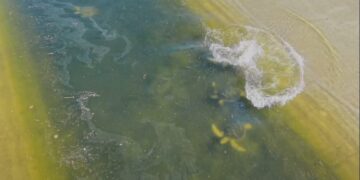
There were approximately 20 turtles, swimming and feeding in a section of the river that looked more like an engineered flood channel than a natural wildlife refuge.
For years, the turtles had been quietly occupying this unlikely habitat, attracting the attention of researchers, conservationists, and people who live nearby.
Their presence raises a fascinating question: Why would animals capable of traveling thousands of miles through the Pacific Ocean choose to spend time in a concrete river?
The answer involves warm water, available food, and a wetland ecosystem that has survived alongside urban development.
But the same river that provides these turtles with a place to live also exposes them to pollution, discarded fishing equipment, and other hazards.
One turtle, a female named Porkchop, would become a particularly memorable example of both the dangers of this unusual habitat and the efforts to protect the animals living there.
The First Sightings Surprised Local Researchers
The story of Southern California’s river-dwelling sea turtles began attracting attention in 2008.
That year, observers documented green sea turtles in the lower San Gabriel River, near Long Beach.
The discovery was unusual because eastern Pacific green sea turtles are more commonly associated with warmer waters farther south.
Southern California lies near the northern edge of their regular coastal range, making a resident group in this location particularly interesting to scientists.
The San Gabriel River flows through Los Angeles and Orange counties before reaching the Pacific Ocean. Much of its course has been modified with concrete channels designed to manage floodwater and protect surrounding communities.
The lower river is a meeting place between urban infrastructure and the coastal environment.
It may not look like a place where sea turtles would choose to remain, but appearances can be misleading.
The turtles were not simply passing through on a single unusual day. Continued observations showed that they were using the area repeatedly.
Over time, the discovery led to closer monitoring of the animals and their habitat.
What had initially seemed like an unexpected wildlife sighting became an opportunity to study how a threatened marine species uses an environment heavily altered by human activity.
The Concrete River Offers Something the Turtles Need
Green sea turtles are reptiles, and water temperature plays an important role in their daily lives.
Unlike mammals, they depend on external sources of warmth to help regulate their body temperature. Colder water can affect their activity, feeding, and movement.
That makes relatively warm areas especially valuable.
The lower San Gabriel River provides conditions that can attract turtles searching for suitable temperatures.
Some sections are shallow enough to warm under the sun. Nearby power plants have also discharged warmer water into the river, contributing to temperatures that can be favorable for the animals.
Writing for California Curated, Olsen explained that green sea turtles seek thermal refuges, places where water temperatures allow them to remain active and comfortable.
This helps explain why turtles might spend time in an environment that, from above, appears to offer little natural appeal.
The concrete walls are not what draws them.
The conditions in the water are much more important.
And warmth is only part of the story.
The lower river also provides access to algae, an important food source for green sea turtles.
Instead of constantly searching for new feeding areas, turtles using this section of the river can find food within a relatively concentrated habitat.
For animals that depend on suitable water temperatures and reliable feeding opportunities, that combination can make an unlikely location useful.
A Wildlife Refuge Hidden Among Roads and Power Plants
The lower San Gabriel River is not an untouched wilderness.
Its banks include concrete structures, bridges, and industrial facilities. Much of the surrounding area has been shaped by decades of urban development.
Yet the river remains connected to the Pacific Ocean and nearby coastal wetlands.
Those connections matter.
The Los Cerritos Wetlands, near the lower river, provide habitat and feeding opportunities for wildlife. Although development has altered the surrounding landscape, the remaining wetlands continue to support an important coastal ecosystem.
For green sea turtles, this creates an unusual combination of conditions.
They have access to water connected to the ocean, areas with favorable temperatures, and vegetation they can feed on.
Researchers believe these characteristics help explain why the turtles continue using the lower river.
There may also be some protection from dangers they would encounter elsewhere, although the river is far from free of threats.
The result is an unexpected wildlife habitat in a place many drivers pass without knowing what lives below.
Under bridges and beside concrete banks, sea turtles carry on with the ordinary business of feeding, swimming, and resting.
There May Be More Than 100 Turtles in the Area
The original sightings did not remain isolated observations.
Over the years, researchers and volunteers have continued documenting green sea turtles in the San Gabriel River and the nearby Cerritos Wetlands.
Olsen reported that estimates suggest well over 100 turtles may use the surrounding habitat.
That figure should be understood as an estimate rather than an exact population count.
Sea turtles are not particularly easy animals to census. They spend much of their time underwater, and individuals may move between feeding areas, channels, and coastal waters.
A turtle visible during one observation may be submerged or somewhere else during the next.
Repeated monitoring is therefore important for understanding how many animals use the area and whether their presence changes over time.
For local conservationists, the continuing sightings are encouraging.
They show that this heavily modified waterway is providing resources used by a threatened marine species.
But the presence of numerous turtles does not automatically mean their future is secure.
A habitat can support wildlife while still exposing the animals to serious dangers.
In the San Gabriel River, those dangers are difficult to ignore.
The Same River That Shelters Them Is Filled With Pollution
Although the water provides warmth and food, the San Gabriel River has another side.
Like many waterways running through densely populated communities, it carries pollution and discarded materials from surrounding urban areas.
Litter, plastics, and fishing equipment can enter the water and remain there.
For sea turtles, those objects can become dangerous obstacles.
A turtle may become entangled in discarded fishing line, restricting its movement and potentially causing serious injuries.
Plastic and other debris can also create hazards when animals encounter or accidentally ingest them.
The fact that turtles are using the river does not mean the water is clean or that the environment is healthy in every respect.
Wild animals often make use of habitats that provide some essential resources while exposing them to other risks.
For the San Gabriel River turtles, the balance is particularly complicated.
Warm water and algae appear to make the area attractive, but pollution threatens the animals that have gathered there.
One of those turtles became the subject of a rescue after a piece of discarded fishing equipment caused a serious problem.
Her name was Porkchop.
Porkchop’s Rescue Showed How Dangerous Fishing Line Can Be
Porkchop was a green sea turtle living in the San Gabriel River area.
She was found in trouble after becoming entangled in discarded fishing line.
Fishing line can be especially hazardous to aquatic animals because it is difficult to see underwater and can wrap tightly around a flipper or other body part.
As an animal struggles or continues moving, the line may tighten and cause additional damage.
Porkchop needed assistance.
Rescuers removed her from danger, and she received veterinary treatment and rehabilitation.
Her situation demonstrated that the hazards in the river were not merely theoretical concerns.
A turtle living in this otherwise useful habitat had been seriously injured by something left behind by people.
After receiving care, Porkchop was eventually released back into the San Gabriel River.
Her return was an encouraging outcome for the people involved in her recovery.
But it did not eliminate the problem that had caused her injury.
Discarded fishing line and other litter remained threats to turtles using the waterway.
Porkchop had received the assistance she needed. Other animals could encounter similar dangers without being noticed in time.
Her experience became another reason to take the river’s pollution problem seriously.
Erik Olsen Went Looking and Found About 20 Turtles
When Olsen visited the river himself, he had an opportunity to see the animals in the environment that had made them so interesting to researchers.
He parked near a highway and crossed the concrete surroundings to reach a place where he could observe the water.
The turtles were there.
He estimated that roughly 20 were visible during his visit.
Some were swimming beneath bridges. Others were feeding in the water near the infrastructure that has become part of their habitat.
There was something striking about seeing wild sea turtles in such an industrial setting.
These were marine reptiles capable of traveling enormous distances through the Pacific, yet they were using a stretch of water surrounded by the familiar structures of a Southern California city.
They were not performing for an audience or doing anything unusual for sea turtles.
They were simply living.
The remarkable part was where they had chosen to do it.
The sight also made the long-running observations easier to appreciate.
The turtles were not just numbers in research records or distant shapes in photographs.
They were living animals, visible in a place most residents would never think to look for them.
Their Presence Is Changing How People See the River
The discovery of green sea turtles in the San Gabriel River challenges an easy assumption about urban waterways.
Concrete-lined rivers are often viewed primarily as infrastructure.
They carry stormwater, pass beneath roads, and help manage flooding in developed areas.
Many people would not expect them to provide meaningful habitat for a marine species associated with tropical and subtropical waters.
Yet the turtles have shown that wildlife can use parts of these altered environments when suitable conditions remain.
That does not make concrete channels equivalent to healthy natural rivers or coastal wetlands.
Nor does it mean pollution and habitat loss are harmless.
Instead, the turtle population offers an opportunity to better understand how wildlife responds to environmental changes and which remaining features are worth protecting.
The nearby wetlands, food sources, and warmer water all appear to contribute to the turtles’ presence.
Protecting those conditions while reducing harmful pollution could make the area safer for the animals that use it.
Porkchop’s rescue showed the importance of responding when individual animals are injured.
The larger challenge is preventing avoidable injuries before they occur.
Seeing the Turtles Comes With a Responsibility to Leave Them Alone
For residents of Southern California, learning that wild green sea turtles live nearby can be exciting.
Seeing one surface in a river surrounded by roads and buildings is an unusual experience.
But the turtles remain wild animals.
They need space to swim, feed, and rest without being disturbed.
Anyone observing them should remain at a respectful distance and avoid touching, feeding, chasing, or attempting to move them.
Their presence in an urban environment does not make them accustomed to handling by people.
The same caution applies to the surrounding habitat.
Leaving fishing line, food packaging, or other litter near the water can create risks long after the person responsible has gone home.
Porkchop’s injury showed how a single discarded item can affect an animal.
For people who want the turtles to remain in the area, responsible observation and a cleaner river are more useful than trying to interact with them.
The best encounter is one in which the turtles can continue doing what they were doing before anyone arrived.
The Sea Turtles Have Made an Unlikely Place Part of Their Lives
Back in 2008, the sight of green sea turtles in the lower San Gabriel River seemed surprising.
Nearly two decades later, their presence has become a subject of ongoing research and local interest.
They have been observed swimming and feeding near bridges, power plants, and wetlands, using a waterway that looks very different from the coastal habitats most people associate with sea turtles.
Their story is not simply one of wildlife thriving despite human development.
It is more complicated than that.
Some features of the altered environment appear to provide favorable conditions, while others expose the animals to pollution and injury.
The same river that offers warmth and food can also contain discarded fishing line capable of causing serious harm.
Porkchop survived her encounter with that danger and returned to the water after receiving care.
Other turtles continue using the area, while researchers and volunteers work to better understand their presence.
When Olsen visited, he found approximately 20 turtles going about their lives beneath the bridges and beside the concrete banks.
There was no tropical island in sight.
No remote beach, no clear blue lagoon.
Just a Southern California river, flowing through a landscape shaped by people.
And beneath its surface, wild green sea turtles were swimming, feeding, and finding their place in one of the last environments anyone might have expected them to call home.








Discussion about this post