



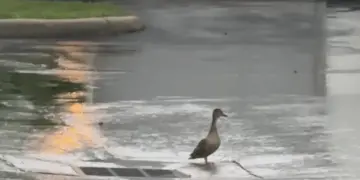






There was nothing particularly unusual about seeing a duck outdoors. But as they continued watching, they noticed something that made them look again.
The duck kept lingering around a storm drain.
She wasn’t moving on with her day. She remained near the opening, paying attention to something the couple couldn’t yet see.
When Andrea and Andrew walked closer, they began hearing faint, high-pitched sounds coming from beneath the street.
They looked down through the drain.
At the bottom was a group of tiny ducklings, huddled together and unable to get out.
The adult duck was their mother.
And while her babies were trapped below, she had stayed nearby.
The situation was already troubling, but the weather made it more urgent. Rain was pouring down, and the couple knew that water could rise quickly inside a storm drainage system.
They had found the ducklings. Now they needed a way to reach them.
A Mother Duck Drew Their Attention to the Drain
The rescue began with an ordinary neighborhood sighting.
Andrea and Andrew noticed the adult duck moving around the area. Initially, they had no reason to think she needed assistance.
Then they realized she was spending an unusual amount of time near a storm drain.
That behavior caught their attention because the duck appeared to have a particular reason for remaining there.
Wild ducks normally move between places to feed, rest, and care for their young. A mother with ducklings often stays close to them, although the family can become separated when young birds encounter obstacles they cannot navigate.
Storm drains present one such hazard.
Their openings allow rainwater to flow off streets and into underground drainage systems. Small ducklings can become trapped below street level, unable to climb back through the opening.
For the ducklings Andrea and Andrew found, the barrier was already in place.
They were at the bottom of the drain.
Their mother remained above.
The couple did not know how long the little birds had been there or exactly how they had become trapped. What they could see was enough to establish that the family needed assistance.
The ducklings were alive, making sounds, and unable to reach their mother.
Tiny Squeaks Were Coming From Below the Street
As the couple approached the drain, the faint noises became an important clue.
They could hear the ducklings before they had a clear view of them.
Looking through the opening, Andrea and Andrew discovered the little birds gathered at the bottom.
The distance between the street and the trapped ducklings presented an immediate problem.
The couple could not simply reach down and lift them out while the drain cover remained in place.
And the rain was not letting up.
“It was pouring rain,” Andrew later explained in a video for The Dodo. “You’ve gotta be careful because sewers can fill up with water.”
His concern was practical.
Storm drainage systems are designed to carry runoff during rainfall. Water levels and currents can change rapidly, sometimes with little warning at a particular opening.
A group of tiny birds trapped inside such a system may have few options for escaping rising water.
Andrea and Andrew understood that leaving the ducklings there could become increasingly dangerous.
At the same time, attempting to access a storm drain carried risks of its own.
The couple needed assistance, and their first decision was to call people equipped to respond.
They contacted the fire department.
They Called for Help, but Time Was Running Out
After making the call, Andrea and Andrew remained near the drain.
The mother duck was still in the area, and her babies were still below the cover.
They waited for assistance, hoping the situation could be resolved before the continuing rain created a greater hazard.
But as time passed, the couple became concerned that help would not arrive soon enough.
“We were fighting against time,” Andrew recalled.
There was no way for them to know precisely how quickly conditions inside the drain might change.
That uncertainty was part of the difficulty.
They could see the trapped birds. They could hear them. They knew the rain was continuing, but they could not yet reach the bottom.
The mother duck’s presence added another element to the scene.
She had remained close to the place where her ducklings were trapped. Her behavior suggested that the drain continued to hold her attention, although no one could know exactly what she understood about the problem.
Andrea and Andrew wanted to reunite the family.
With assistance not arriving within the time they believed was available, they began looking for another way to open the drain.
It was not a straightforward task.
The cover was heavy, and neither of them had arrived expecting to conduct an animal rescue.
They turned to something readily available: an internet search.
A YouTube Video Gave Them an Idea
Andrea described how they began searching online for instructions on whether a storm drain cover could be lifted.
“We started Googling, ‘Is it possible to just lift the sewer drain lid?’” she told The Dodo.
The question reflected how unfamiliar the task was.
They had never expected a walk through the neighborhood to involve figuring out how to open a street drain.
Eventually, they found a YouTube video showing someone lifting a drain cover.
It gave them an idea of what might be possible.
Andrew decided to try.
Using his strength, he managed to lift the heavy cover off the drain by himself.
It was a critical moment in the rescue.
Until then, the couple had been separated from the ducklings by a barrier they did not know how to remove.
Now they had an opening large enough to begin retrieving the little birds.
Removing a storm drain cover during heavy rain is hazardous, and the circumstances of this particular rescue should not be treated as a general method for handling trapped wildlife. The couple were making a decision under time pressure, with the ducklings visibly trapped below.
Their immediate problem was no longer how to open the drain.
It was how to bring the babies out together.
A Laundry Basket Became Their Rescue Equipment
Andrea and Andrew needed something that could hold the ducklings while they brought them up from the bottom.
They used a laundry basket.
It was an ordinary household item, but in that moment, it gave them a way to collect the little birds and move them together.
The couple worked as a team, carefully scooping the ducklings into the basket.
Each little bird had to be gathered from the drain.
The task required attention because the animals were small, the space was confined, and the weather had already made the situation urgent.
The couple continued until all the ducklings were inside.
Throughout the effort, their mother remained nearby.
“The mother duck was waiting right next to the grass area,” Andrew said.
Her presence meant the couple did not have to search for her after collecting the babies.
She was already there.
For young ducklings, remaining with their mother is important. She guides them through their surroundings, provides warmth when needed, and helps them respond to the environment as they grow.
Being trapped below the street had separated the ducklings from that care.
The basket offered a way to close the distance.
Andrea and Andrew had managed to gather the entire group. The next step was to bring them out and give them the opportunity to return to their mother.
The Ducklings Went Straight Toward Their Mother
Once all the babies were in the laundry basket, Andrea and Andrew lifted them out of the drain.
They moved the basket to where the birds could be released safely.
Then they gently tipped it, allowing the ducklings to come out.
The tiny birds wasted no time.
As soon as they were free, they began waddling toward their mother, who was waiting nearby.
The separation that had seemed so difficult to resolve only minutes earlier was finally ending.
The mother duck did not need to be carried over to them.
She was already close enough for her babies to reach her.
“It was just beautiful to see the baby ducks running towards the mom,” Andrew recalled.
After the urgency of trying to open the drain and collect every duckling, the reunion was strikingly simple.
The little birds moved toward a familiar adult.
Their mother was there to receive them.
Andrea and Andrew watched as the family came back together.
They had not needed to move the ducklings to another location or arrange a new home for them. Their mother had remained in the immediate area throughout the rescue.
The goal had always been to return the babies to her.
And now that had happened.
The Entire Rescue Took About 45 Minutes
From the time Andrea and Andrew first discovered the trapped ducklings until the family was reunited, approximately 45 minutes had passed.
It was less than an hour, but a great deal had happened.
The couple had noticed a duck behaving unusually near a storm drain.
They had heard the ducklings below, called the fire department, waited for help, and realized the continuing rain made the situation more urgent.
They had searched online for a way to access the drain, removed the cover, and used a laundry basket to retrieve the babies.
Through those stages, the mother duck had stayed close.
The final moment was the one they had been working toward: watching the ducklings walk back to her.
Andrea later described how much that reunion meant to her.
“I felt how happy and relieved that mother duck was,” she said. “It was just such a special moment.”
Her words reflected the emotion of watching the family reunite after the uncertainty of the rescue.
The mother’s exact feelings could not be known, but the behavior was clear.
She had remained near the drain while her babies were trapped.
Once the ducklings were released, they moved directly toward her.
Within 45 minutes, an unfamiliar and potentially dangerous situation had been resolved.
The Duck’s Behavior Had Made the Difference
One of the most memorable parts of the rescue was how it began.
Andrea and Andrew did not set out to find trapped wildlife.
They were not responding to a report about ducklings in a storm drain.
They simply noticed an adult duck spending time in one particular place.
That observation prompted them to investigate.
The mother’s presence near the drain did not mean she understood the stormwater system or knew how humans might be able to help.
Ducks do not need that kind of understanding to remain near their young.
A mother duck can respond to the sounds and movements of her ducklings and stay close when they become separated.
In this case, her behavior was enough to draw the couple’s attention.
Without noticing her repeated presence near the drain, Andrea and Andrew might have continued on without realizing there were birds trapped beneath the street.
Once they approached, the ducklings’ tiny squeaks gave them another clue.
The rescue followed from those observations.
The mother remained nearby.
The ducklings called from below.
And two people recognized that something was wrong.
A Little Family Was Together Again
Not every wildlife rescue involves specialized equipment or a long recovery.
Sometimes the immediate need is to remove an obstacle that has separated young animals from a parent.
That was the situation Andrea and Andrew encountered.
The ducklings had become trapped at the bottom of a storm drain during heavy rain. Their mother remained above, unable to bring them out herself.
The couple’s decision to investigate, seek assistance, and ultimately retrieve the little birds changed the outcome of that encounter.
The story does not establish what happened to the duck family in the days or weeks afterward.
There is no need to invent a later chapter.
The important moment was already there, beside the grass near the storm drain.
Andrea and Andrew had lifted the babies out in a laundry basket.
They had gently released them.
And without hesitation, the little birds had made their way back toward their mother.
What began with a duck lingering over an opening in the street ended with the entire family reunited.
The couple had spent 45 minutes trying to make that possible.
For Andrea, the sight of the ducklings returning to their mother stayed with her.
The rain had made the rescue urgent. The heavy cover had made it difficult. And the tiny sounds from below had helped the couple understand what needed to be done.
But the last part required no complicated equipment.
Once the ducklings were safely out of the drain, they knew where to go.
Their mother was waiting in the grass.
And one by one, they went back to her.












Discussion about this post