
On Nora’s fourth visit to the animal sanctuary, the dog she had come to see finally stepped out where she could see him, too. He stood half hidden behind a wooden divider, watching a length of dark green yarn pass through her fingers.
It would have been the most natural thing in the world to look up and say his name. She had spent two hours in that chair on her first morning without so much as a glimpse of him. She had come back twice since. Now, at last, here he was.
Nora kept knitting.
For nearly forty minutes, Brutus stood there watching her. Then he went back inside. They were still fifteen feet apart, exactly as far from each other as they had been when she first unfolded her chair. What had changed was that, for forty minutes on an ordinary morning, he had chosen to be where she was.
At Red Creek Animal Sanctuary, outside Asheville, North Carolina, there were people who had been waiting almost nine months to see him do that.
The photograph everyone saw a little differently
Brutus lived in the last run. Visitors coming down the row usually caught sight of him before they reached the handwritten card on his gate. He was a black Cane Corso, seven years old and close to 110 pounds. He had cropped ears, old scars beneath his short coat, and a small piece missing from his lower lip.
Some people slowed down when they saw him. Others gave the gate a generous amount of room. Either way, by the time they were close enough to read the card, Brutus was generally on his way into the covered section of his enclosure. There he would stand with his face toward the wall until they went away.
The card asked visitors to keep their hands outside the gate. It explained that strangers made him nervous and that he needed a quiet home with someone experienced. All of that was accurate. It was also a difficult introduction to get past when the dog himself had gone around a corner and intended to stay there.
A family with a large fenced yard came to meet him. They had the kind of place where he might have been comfortable, but after seeing him, they decided against taking him home. A man who had owned a mastiff drove almost three hours to the sanctuary. Brutus never came out from behind the divider. At the end of the visit, the man faced another three hours on the road, having learned very little about the dog he had driven all that way to see.
There wasn’t much the staff could tell a visitor about his early life. Someone had found him beside an abandoned warehouse after a winter storm. He was dehydrated and underweight, with a piece of broken chain dragging behind him. His nails had grown painfully long. Around his neck was a narrow strip of damaged skin where a collar had once been too tight.
Nobody came looking for him. The people at Red Creek had no way of knowing who had put the collar on him, how long he had worn it, or where he had been before he turned up at the warehouse. A raised arm made him flinch. That much they could say because they had seen it happen.
The veterinarian who examined Brutus saw what fear looked like in a dog of his size. First his body went rigid. Then he lowered himself until his stomach touched the floor and fixed his eyes on the ground. A person walking past might see a powerful dog holding very still. Someone who stayed a little longer would see how long it took him to get back up.
Experienced handlers sat by his run. Behavior specialists brought treats. Volunteers left blankets carrying their scent. Once the footsteps had faded, Brutus would come out and investigate what they had left for him. He had an interest in the things people brought. It was finding those things with the people still there that proved too much.
Eventually, the sanctuary stopped arranging ordinary introductions for him. His photograph was still online, though. That was where Nora found him.
The questions Nora asked
Nora was fifty-two. She cleaned classrooms at a community college at night and lived alone in a modest house with several wooded acres around it. Years earlier, she had fostered senior dogs, including some who had been neglected. She understood what the sanctuary meant by a quiet home, and she knew what her own house was like on an ordinary day. That part seemed a reasonable fit.
What held her attention was a small detail in Brutus’s photograph. His body was turned away from the camera, as though he had already decided to leave. His eyes, though, were still on the person taking the picture. Nora kept looking at them. She had seen enough frightened dogs to recognize one who wanted to know what a person was going to do next.
She emailed the sanctuary. The adoption coordinator tried to give her an honest idea of what she might be taking on. Brutus could startle at familiar sounds. He might always find it difficult to have company in the house. Even if he grew accustomed to the person who fed him and shared a home with him, there was a chance he would never willingly let that person touch him.
That last possibility was worth thinking about. Most people looking forward to bringing a dog home can already picture a few things. A hand resting on a warm head. A dog settling against a leg in the evening. The coordinator was asking Nora to imagine looking after Brutus for years without being able to count on either one.
“Then I won’t begin by trying to touch him,” Nora replied.
She arrived the following Tuesday shortly after sunrise. She wanted to know when Brutus ate and where he usually slept. Which sounds bothered him? Given the choice, did he spend more time in the covered enclosure or outside in his run?
People who had come hoping to adopt him naturally wanted to know how he behaved during a visit. Nora’s questions gave the staff a chance to describe the rest of his day. There was a dog who came out to inspect a blanket after the person who had left it was gone. There was a dog who liked the outdoor part of his run well enough once the building quieted down. It helped to know those things about someone she might otherwise meet only as a face turned toward a wall.
Nora set her folding chair about fifteen feet from the enclosure. She had brought yarn and knitting needles. There was no leash hanging from the arm of the chair and no treat in her hand waiting for Brutus to come and take it. She settled into her seat and started a dark green scarf.
Two hours went by. Brutus stayed inside. When it was time to leave, she put the unfinished scarf over the back of her chair and asked the staff to leave it there. She would pick it up again in the morning.
Fifteen feet from the gate
One advantage of bringing her knitting was that Nora had somewhere to look. If Brutus put his nose around the divider, he wouldn’t find a woman sitting with her hands in her lap and her eyes fixed on the exact spot where his face would appear. He could take a look at her while she was occupied with something else.
She returned the next morning, then again two days later. Sometimes she hummed while she worked, so softly that volunteers passing along the walkway could barely hear the tune. Sometimes she sat listening to the rain. When it was time for her to go, she left the knitting on the chair, whether Brutus had come out or spent the entire visit under cover.
After that fourth morning when he watched her for nearly forty minutes, there was no reason to change the arrangement. The chair stayed where it was. On her sixth visit, Brutus remained outside for the entire hour.
On the ninth, he lay down where he could see her through the fence. It made a different picture from the one that had first caught her attention online. In that photograph, his body had been turned away, ready to carry him somewhere else. Now he was comfortable enough to fold his legs under him and stay awhile.
By the third week, Nora would sometimes arrive to find him waiting near the wooden divider. He could watch her take her seat and gather the green scarf into her lap. They could spend an hour together that way without his ever coming close enough for her to touch him.
It was easy to imagine, on one of those quiet mornings, that the hard part was behind him. Then came an evening when thunder shook the metal roof, and the dog who had learned to wait for Nora could hardly get far enough into the corner of his own enclosure.
A spilled cup of coffee
The rain began shortly before closing. Water blew beneath the covered walkways, and Brutus pressed himself against the back of his run. He was trembling hard enough that his water bowl rattled against the floor.
Nora happened to be there. The staff suggested she cut the visit short. There was little she could do about thunder hitting a metal roof, and Brutus had already gone as far from the walkway as the building allowed. She asked the director if she could stay anyway.
The director agreed, with two conditions. Nora was to remain outside the locked enclosure, and she was to call for help if anything changed. She moved her chair beneath the narrow awning, closer to the gate than usual, and wrapped a blanket around her shoulders.
From the rear of his enclosure, Brutus could hear the tune she had hummed on other visits. He stayed where he was. As the evening grew colder, a staff member brought Nora a second blanket and a cup of coffee. The coffee went on the arm of her chair. She kept the scarf in her lap.
It was around midnight before the rain let up enough for Brutus to show himself. He stood at the entrance to the covered portion of his run. Nora went on knitting. After a while, he took a step toward the gate. Several minutes passed before he took another.
He had made it halfway across when thunder cracked above the building. Brutus jumped backward. Nora’s cup slipped from the arm of her chair and hit the concrete.
The dog froze. Coffee was spreading across the walkway, the cup was on the ground, and Brutus was watching Nora. Earlier in the evening, each new sound had sent him searching for a place to hide. This time, the thing that held his attention was the person beside the spill.
Nora bent down, picked up the empty cup, and set it aside. Then she gathered her knitting and went on with the scarf.
There was no way to explain to him that a cup balanced on the arm of a camping chair was bound to fall sooner or later. He had to watch her pick it up. He had to see for himself what happened afterward. From his side of the gate, he could see her hands returning to the same work he had watched her do for weeks.
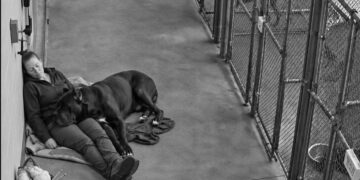
The night wore on. Shortly before four in the morning, Nora got out of the folding chair and sat on the concrete with her back against the wall. She put the folded blanket beside her and closed her eyes. Brutus was still several feet away, on the other side of the gate.
For once, after all those mornings she had spent wondering whether he would come any closer, he began to move and she missed it.
What the overnight camera caught
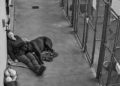
When a shelter employee looked back through the recording, she could see that Brutus spent almost twenty minutes studying Nora. The woman sitting on the ground was familiar by then. So was the scarf. Part of it had slipped through the gap at the bottom of the gate and lay within reach on his side.
He came forward, lowered his nose, and smelled the wool. Then he lay down. He left a little room between himself and the bars at first. After a while, he shifted closer and placed one large paw on the edge of Nora’s knitting.
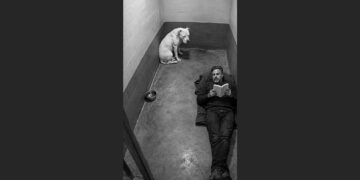
When Nora opened her eyes, the dog she had spent two hours waiting to see on that first Tuesday was lying beside her. Only the gate stood between them. She rested a hand on the concrete a few inches from the bottom bar, with her palm turned up.
Brutus looked at it. She left it where it was. Then he worked his muzzle beneath the bars and, very carefully, laid his chin across her palm.
Nora felt tears coming. She could feel the weight of his head, too. It would have taken the smallest movement of her thumb to stroke his face. A few weeks earlier, the adoption coordinator had warned her this dog might never allow anyone to do that. Now that she had the chance, Nora kept her fingers still.
She had said she wouldn’t begin by trying to touch him. It turned out she could keep that promise even with his chin resting in her hand. He could lift his head whenever he liked. He settled a little more heavily into her palm and fell asleep.
At 6:47 that rainy Thursday morning, an employee checking the cameras saw Nora on the blanket beside the gate. Brutus was pressed against the other side, his head as close to her lap as the barrier allowed. The morning crew arrived and left them where they were.
The director stood at the end of the walkway with tears running down her face. She had seen experienced people try for months to find a way to reach this dog. What moved her was remembering how many chances Nora had been given to hurry him along. Even at the very end, with his face resting in her hand, she had let him decide how close the two of them were going to get.
Six minutes on his side of the gate
Nora continued visiting for another two months. The night of the storm gave her a lovely memory to carry home. It also left her with the same practical question she had faced on the first Tuesday. The next time she came, what would Brutus feel comfortable doing that day?
Eventually, he grew comfortable enough for her to come inside his enclosure. Their first visit without a gate between them lasted six minutes.
Nora sat on the ground. Brutus walked around her cautiously. For weeks, he had known her chiefly as a woman seated on the other side of a fence, usually with a growing length of green wool across her knees. Now there was room to walk all the way around her. When he reached her back, he stopped and leaned his shoulder against it.
That became something Nora could recognize as easily as another person might recognize a dog dropping a ball at their feet. Brutus continued to dislike unfamiliar hands coming toward his head. When he wanted to be close, he came alongside and leaned. A Cane Corso weighing nearly 110 pounds could make himself quite clear that way.
The sanctuary approved Nora’s adoption application in early spring. The staff expected that getting him to leave the enclosure, cross the parking lot, and climb into a vehicle might take some doing. There had been a time, well within everyone’s memory, when the distance from the wooden divider to the gate had been too much to ask of him.
Nora walked across the lot. Brutus followed her. When she reached the car, he climbed into the back seat and lay down beside the dark green scarf.
Somewhere in the course of all those visits, she had finished it.
The rug beside Nora’s chair
During his first few days in Nora’s house, Brutus slept beside the back door. There were several wooded acres outside and a whole house available to him, but that first small stretch of floor suited him. After a few days, she began finding him in the hallway. Later, he made his way into the living room.
By the end of his first month at home, he had settled on the rug beside Nora’s favorite chair. After spending so many mornings carrying a chair to the place where Brutus lived, she could sit down in her own living room and have him come looking for her.
Thunder still frightened him. If an unexpected noise caught him off guard, he went to find a safe corner. He was cautious around people he didn’t know. The coordinator’s early assessment had been a fair one, and Nora had taken it seriously. She had been prepared to give him a quiet place to live even if he chose to sleep by the back door for the rest of his life.
Nearly a year after the adoption, a photograph arrived at Red Creek. It showed Nora sitting on her porch, knitting in the afternoon sun. Around Brutus’s neck, loose against his black coat, was the green scarf the staff had first seen draped over a folding chair.
Nora included a few lines about the question people kept asking her. They wanted to know what she had done to make Brutus trust her. “I stayed close enough for him to find me,” she wrote, “but far enough away for him to feel safe.”
The people who remembered her first morning could have told you what that distance once measured. There had been fifteen feet of walkway, a locked gate, and a wooden divider beyond it.
In the photograph, Nora would have had to wake him to get up from her chair. Brutus was sound asleep with his head across her feet.



Discussion about this post