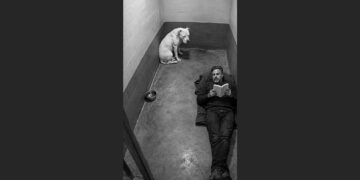



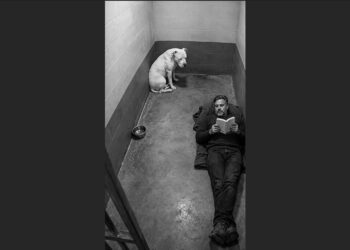
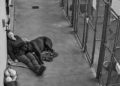
Ethan was well into his paperback by the time Titan came up behind him. On earlier visits, the big white dog had stayed far enough away that Ethan could see most of him without looking up from the page. Now Titan was close to his shoulder, in the one place Ethan couldn’t see without turning around.
The shelter employees watching on the monitor had a better view. They could see the notch in Titan’s ear, the scars along his front legs, and the few inches of floor still separating him from the man on the blanket. They could also see that the way back to his corner was clear.
That mattered. Earlier that evening, a metallic crash had sent nearly ninety pounds of frightened dog scrambling for the back wall. Ethan had stayed seated while Titan put all the distance he could between himself and that sound. It had taken much of the evening for him to cross the floor again.
Now he stood sniffing the back of Ethan’s sweatshirt. A minute went by, then another. Ethan held the paperback open and left his feet where they were.
To understand why two people watching a monitor could find it hard to take their eyes off a man reading a mystery, you had to know something about Kennel 32.
What the notices on his gate could tell you
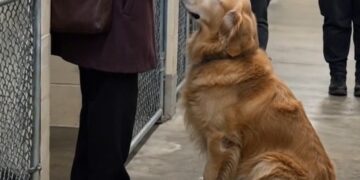
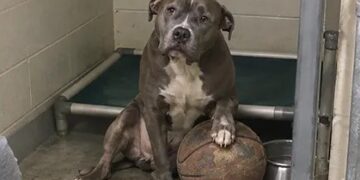
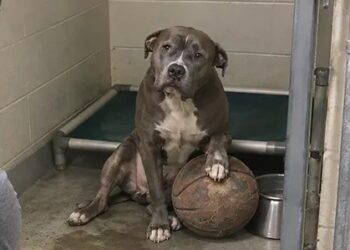
Most visitors first saw Titan from the aisle. There were notices outside his kennel asking people to keep their distance, and behind them was a large white pit bull sitting against the far wall. The notices served their purpose. People gave him room. Most were already looking toward the next dog by the time they passed his gate.
Titan had been returned from previous placements and transferred between facilities. His records traveled with him, so by the time he reached Kennel 32, the shelter had plenty to read about how carefully he needed to be handled. There was considerably less about what had happened to him in the first place.
His scars drew the eye. They told the staff where he had been hurt, though little about the circumstances. More useful, on any given afternoon, was what they could learn by paying attention to the dog in front of them. A gate slamming could send him hard against the back wall. A person who moved too quickly might find that Titan spent the rest of the visit trying to stay as far away as the enclosure allowed.
Food made the difficulty especially plain. An employee could set his meal within easy reach and step back. Sometimes Titan would wait until the person had left before he approached his bowl. From the aisle, he might look like a dog with very little interest in supper. The empty bowl an employee found later told the other half of it.
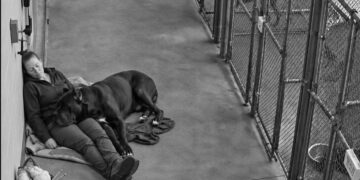
The staff kept their sessions short. They gave him space to retreat and paid attention to what he could manage while somebody was still nearby. On a good afternoon, they might get a glimpse of a dog who could settle in company. The next day, the sound of metal striking metal could take up the better part of their time together.
A behavioral review was scheduled. The staff needed to talk about Titan’s future, including how he could receive ordinary care and what kind of placement could reasonably meet his needs. People who had spent time with him worried about how that meeting might go. They knew more about the circumstances that frightened him than they did about the life in which he might be comfortable.
Around then, a man in his late forties began asking about the dog in Kennel 32.
A paperback and a place on the floor
Ethan listened to what the employees had to say, learned the shelter’s procedures, and waited while they considered whether Titan could tolerate having him nearby. When they approved a session at a safe distance, he brought a blanket and a paperback mystery.
He spread the blanket on the floor, sat sideways to Titan, and opened the book.
There was a practical advantage to having something worth reading. A person sitting empty-handed in the presence of a dog tends sooner or later to look at the dog. If the dog takes a step, the person notices. If he comes a little closer, there’s a temptation to put out a hand. With the mystery in his lap, Ethan had somewhere else to direct his attention and something perfectly ordinary to do with his hands.
For a while, anyone passing would have seen much the same arrangement from one visit to the next. A man sat on a blanket reading. A white dog stayed some distance away. When the session was over, Ethan took his book and blanket with him. Another day he came back.
It would be hard to say which visit first made a difference to Titan. The first change anyone could see was the day he lay down while Ethan was there. He still had plenty of floor between himself and the blanket. What interested the employees was that he had found a position he could rest in before the person sharing the space had gone away.
Later, he began to take a few hesitant steps in Ethan’s direction. The arrangement gave him time to stop partway. Ethan had never required him to come all the way to the blanket, so there was no particular point on the floor at which a visit succeeded or failed. Titan could spend the afternoon several feet closer and still go back to his familiar place.
Then came the evening of the crash. One minute Ethan had his book open and Titan was managing the visit. The next, the dog was pressed against the wall again. Ethan stayed on the floor. There was nobody between Titan and his corner, and nobody followed him there to insist on comforting him.
As time passed, Titan began to come forward. Instead of stopping where Ethan could easily see him, he made his way around behind the seated man. That was where the employees saw him pause, his nose a few inches from Ethan, with the route back to the wall still open.
For nearly ten minutes, he stood there. Then he lowered his head.
The weight of his chin
The first contact was so slight it would have been easy to miss. Titan touched his chin to Ethan’s hiking boot. He stayed there a little longer and let the worn leather take some of the weight of his head.
Ethan stopped turning pages.
For a dog who had spent whole visits at the far end of an enclosure, there was something almost startling about seeing him choose such a homely place to rest. It was a shoe. Ethan had worn it to walk into the building and across the floor. Of everything available to Titan that evening, it happened to be the part of a person he felt able to touch.
Ethan left his hands on the book. Reaching down would have changed the arrangement for both of them. He would have had to bend over Titan, and Titan would have had a hand coming toward his face. For the moment, the dog seemed comfortable with things as they were. Ethan was willing to sit with one foot occupied.
One employee put a hand over her mouth. Another began to cry. They had seen Titan close enough to a person before, of course. His care sometimes required people to come near him. What they were seeing now was Titan covering the last few inches himself and remaining where he had arrived.
Ethan lowered his head. His shoulders moved a little. After a while, he wiped his face against the sleeve of his sweatshirt.
Someone later gave him a little good-natured teasing about crying because a dog had touched his shoe. It was a fair description of what had happened, and Ethan didn’t mind it. He had spent enough evenings looking across that stretch of floor to remember when the distance between them had seemed considerable.
There was no attempt to see what else Titan might allow before the visit ended. Ethan didn’t use the opportunity to scratch his ears or run a hand over his back. The next time he came, he would find out how Titan felt about company on that particular day.
What went into Titan’s record the next morning
A visitor who had heard about the boot might have gone straight to Kennel 32 expecting to find a dog waiting at the gate. Titan was still cautious when employees entered. Loud sounds could still send him away from people. A stranger standing in the aisle would have recognized the dog described on the notices.
During Ethan’s next visit, though, he settled sooner. After enough afternoons spent waiting for him to be comfortable, the employees could appreciate what it meant to have a little more of a session left once he was.
Other changes came separately, over time. One day a front paw rested against the edge of the blanket. On another, Titan lay on his side. Until then, even when he lay down, he often kept his legs tucked tightly beneath him. Stretched out on one side, he occupied rather more floor. It was a lovely sight for people accustomed to seeing that big body crowded against a wall.
Eventually, he accepted a brief scratch under his chin. The staff wrote these things down alongside the difficult afternoons. Whoever came on duty next needed to know both how close Titan had felt able to come and what had been happening around him at the time.
Raised voices bothered him. Fast-moving hands did, too. A sudden approach was particularly hard when a person had stepped into the space Titan would otherwise use to get away. As the employees recognized those patterns, they could change the way they entered a room or where they stood once they got there.
Later records suggested that somewhere in his earlier life there had been neglect, confinement, and harsh handling. Some questions about his past stayed unanswered. The additional information helped put his behavior in context, but it was what the employees saw each day that helped them decide how to approach him the next morning.
The work continued for months. Titan began eating with familiar people nearby. That gave his caregivers a chance to see something as simple as the dog enjoying a meal they had brought him. Leash work took careful preparation. Veterinary visits had to be planned around the handling he could tolerate and the need to keep restraint and distress to a minimum.
There were still afternoons when an unfamiliar man moving too quickly could undo the ease of an otherwise ordinary visit. On those days, Ethan might spend much of his reading time across the room again. He kept coming. So did the employees who knew how Titan liked to be approached and who had practical reasons to earn a little of his confidence themselves.
A dog can enjoy the company of one particular man with a book and still have a hard time getting through an ordinary week. Titan would need to let somebody else bring him food, help with his leash, or look after him when Ethan was unavailable. Other experienced employees gradually joined the work. Familiar routines moved into different rooms. The staff watched to see which parts of Titan’s growing comfort traveled with him.
By then, Ethan wanted to bring him home. Before the shelter could agree, there was a house, a yard, and a good deal of daily life to consider.
Getting a house ready for Titan
At the shelter, nearly everybody who came near Titan had some understanding of his history. A house operated differently. A visitor might see a white dog in the living room and instinctively reach toward him. Someone coming through a gate might have no idea what the sound of it slamming could do to the rest of his afternoon.
Ethan and the staff went through his living arrangements in detail. They discussed the fencing, people who might visit, contact with other animals, and where Titan could go when he needed quiet. They talked about veterinary care. They also considered what might happen if Ethan got sick and someone else had to come into the house to look after the dog.
It was quite a leap from having Titan’s chin on his boot to arranging for a backup caregiver. Both belonged to the decision Ethan was making. He knew how it felt to be the person Titan wanted to approach. He had also been there on days when the kindest thing a familiar person could do was sit some distance away with a book.
The transition gave Titan time to get accustomed to a vehicle and to surroundings he hadn’t seen before. Controlled visits came first, then longer stays. The staff could watch how he managed the move from one place to the next before the whole business of living there began.
On the day Titan moved in, there was no group waiting at the house for a picture. His bed had been placed in a quiet corner, away from the parts of a room people needed to walk through. He could lie there without having somebody step around his head to get somewhere else.
He explored one room, then another. For a dog who had lived in Kennel 32, a house offered a surprising number of decisions. He could cross a doorway or stay on the near side of it. He could go back to a room he had already inspected. The bed was available whenever he had seen enough.
Ethan sat down and opened his book. Of all the things Titan was finding in this new place, he had a fairly good idea what happened when that man turned a page.
The first time he turned his back
For the first few weeks, Ethan often did his reading on the living room floor. It was the posture Titan knew best. Some evenings he settled near the book. On others, he found a place across the room and spent the time there.
One day, he went to sleep with his back toward Ethan. Given everything else a dog might do in a new home, that could have passed almost unnoticed. Ethan had spent months with a dog who liked to keep track of where he was. Now he could sit a few feet away and look at the back of Titan’s head while he slept.
There were household sounds they had to learn to live with. A dropped pan could send Titan out of the kitchen. Sometimes voices rose on the television and he quietly left the room. When people visited, Ethan planned for barriers and enough distance to spare Titan an introduction he might find frightening.
In between came the things that would have seemed unremarkable with almost any other dog. Titan ate his meals regularly. He explored the yard. He carried a toy around, and in time there was another toy he liked to carry, too. Sometimes, given his choice of the bed and the rug and the other comfortable places available to him, he took the couch.
Those ordinary preferences were among the things his shelter file could never have told Ethan. The employees had needed to record what happened when a gate slammed, how close somebody could stand while Titan ate, and which kinds of handling required preparation. It took a quieter house and a certain amount of uneventful time to discover where he liked to spend an evening when nothing in particular was being asked of him.
Six months after the move, somebody took the photograph that several shelter employees would come to keep.
Ethan was on the living room floor with another paperback mystery. Beside him, Titan had stretched out with his head near Ethan’s shoulder. One broad white paw lay across the man’s chest. The dog was sound asleep.
When the picture circulated online, people called Ethan a hero. He gave much of the credit to the employees who had prepared Titan for a home, the veterinary care he had received, and the months of work that had continued on all those afternoons when there was little to show for it.
The shelter employees had their own reasons for keeping the picture. They remembered trying to work out a future for a dog who was frightened even to eat with someone in the room. Here he was taking up his fair share of a living room floor, one heavy paw apparently no inconvenience at all to the man trying to read beside him.
Ethan still gets down on the floor with a book sometimes. Titan has other places he likes to sleep now, and some evenings he stays right where he is. He can be uneasy with strangers. Loud surroundings are still hard. At home, the people who know him have learned to leave him a comfortable way through the day.
Every so often, Ethan walks across the living room while Titan is dozing on the rug. A long time ago, that dog would have watched him cover every inch. Now one notched ear lies folded against the floor. A paw twitches a little in his sleep.
Ethan passes within a few feet of him. Titan sleeps on.



Discussion about this post