



The first time Barnaby ran, he got about a hundred yards ahead of me before he turned around. I was seventy-one, standing in the middle of a field with tears on my face, and that old dog had the good sense to wait. If he’d expected me to run the whole way after him, we might still be out there.
A few months earlier, I’d been looking for a young dog who would run to meet me at the door. That was what I thought I wanted when I walked into the animal shelter. I had a yard, time on my hands, and a house that had been altogether too quiet since my wife died.
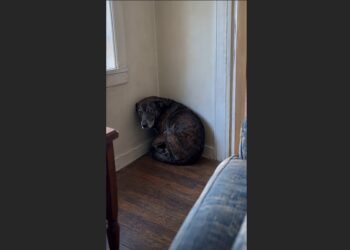
Barnaby had spent two years at the shelter, most of them in one corner of his kennel. He was thirteen. The volunteer who introduced us wanted me to understand that he might never come when I called him. He might take his meals, accept a place to sleep, and live out his remaining years keeping his distance from me.
I took him home knowing that. And for the first several weeks of our acquaintance, if I wanted to hear the sound of my dog enjoying his supper, I had to stand on the other side of a closed door.
The dog Elizabeth wanted me to meet
My name is Arthur Pendelton. I made my living as a craftsman. By the time I met Barnaby, my children had made homes for themselves overseas, and my wife had been gone two years. There was a clock in the living room I could hear from practically anywhere in the house. I’d lived with the thing for years before I ever noticed how loud it was.
What I pictured on my way to the shelter was a cheerful young dog who would make some noise. I could imagine him getting underfoot while I made breakfast and pestering me to go outside when I’d just got comfortable. Both sounded pretty good to me. I’d had enough uninterrupted time to last a man quite a while.
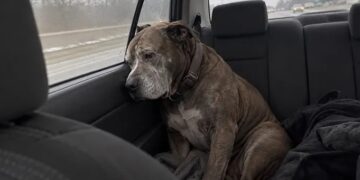
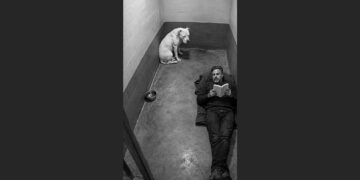
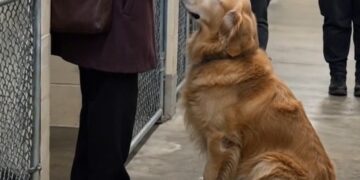
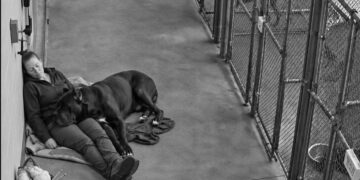
Elizabeth, a volunteer, took me past the livelier kennels and into the quietest part of the building. An old pit bull was tucked into the back of his enclosure. His name was Barnaby. He had spent the first eleven years of his life with one man on a farm. After he lost that man, he came to the shelter, and there he stayed.
Eleven years was a useful thing to know about him. If Elizabeth had told me only that he’d spent two years in a corner, I might have believed that was the whole dog. Before that corner there had been fields, a tractor, and somebody whose footsteps he must have known as well as I’d known my wife’s. He’d had a great deal to get accustomed to losing.
When I told Elizabeth I’d like to take him home, she looked surprised. Then she took some time with me. She wanted to be sure I understood what an ordinary day with Barnaby might look like. I had come in hoping for a dog who wanted to play. Could I be happy with one who might never wag his tail at the sight of me? What if I gave him a good home and he spent his days facing a wall?
I appreciated her asking. There’s a warm feeling that comes over a person who has just decided to do something generous, and it can carry you right past the details of what you’re agreeing to. Elizabeth gave me a chance to think past the drive home. I considered how I would feel a month from then, putting down a bowl for a dog who still wanted to be left alone.
I could do that much for him. Besides, I had become fairly particular about my own company. It seemed a little late in life to start holding that against somebody else.
The spot by the old stone well
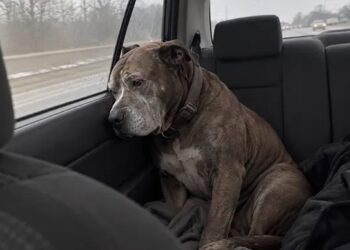
When the paperwork was finished, I opened the back door of my car. Barnaby walked up slowly, climbed onto the seat, and turned his muzzle toward the window. He stayed that way for the whole ride.
I tried talking to him. When I ran out of things to say, I sang a little. My wife used to hum old love songs while we worked in the garden in spring, and pieces of them had stayed with me. It had been a while since I’d had occasion to find out how many words I remembered. Barnaby kept looking out the window, which was a charitable response to my singing.
In the driveway, he stood with all four feet on the ground and took a long look around. I wondered what a place like mine smelled like to a dog who had once known a farm. Then he set off along the side of the house and settled near the old stone well.
Of all the spots he could have picked, that one made me stop. It was well back from the front of the house, tucked away where nobody passing could see much. In the two years since my wife died, I’d spent a good many afternoons sitting there. If I was going to cry, I liked to have a little privacy. Apparently, Barnaby and I had much the same opinion about what made a decent place to sit.
Inside, I had arranged a thick wool mattress for him in the living room. I’d chosen it with his old bones in mind and was rather pleased with it. He walked past it and lay down on the bare floor in the darkest corner of the room. That settled the question of who would be making the sleeping arrangements.
I couldn’t sleep much that first night myself. I sat in my leather chair across from him. A streetlight cast enough light through the window for me to see when his eyes were open. Every once in a while, I’d find him looking my way. Neither of us made much of it. After a bit he’d look elsewhere, and I’d settle back in the chair.
I had gone to the shelter that morning in the hope of hearing some life in the house. By bedtime I had acquired a dog so quiet I had to look across the room to be sure he was awake. Still, when I got up from my chair, I was careful to go around him. It had been two years since I’d had anyone to go around.
Supper on the other side of the door
In those first weeks, Barnaby had one firm condition for taking a meal. I could prepare it, carry it in, and set it down near his corner. Then I had to get out of sight. Even his water could wait if the alternative was drinking it with me watching.
It took me a little while to understand my part. I thought a few encouraging words might help. I’d stand there speaking softly, and he’d turn his head. He was an old dog with a full bowl in front of him, patiently waiting for a grown man to catch on.
Eventually I learned to say a few words as I put his food down and continue straight on into the kitchen or my study. As soon as the door clicked shut, I’d hear him get up. There was the soft tread across the floor, a pause at the bowl, and then the small, unmistakable sounds of a dog eating his dinner.
I came to like hearing those sounds. There was precious little I could do about the years he had spent waiting for the man he’d loved. I could get this one thing right twice a day. He was eating. I could go about my business and let him finish.
We had a different arrangement for the afternoons. I made tea and carried a wooden chair into the living room. I set it far enough from his corner that he had room to get past me if he wanted. Then I sat down and told him whatever happened to be on my mind.
I began with things I could talk about without much difficulty. I told him about my younger days and the years I’d spent making things with my hands. With a whole cup of tea to get through and a listener in no hurry to take over, I eventually got around to the subjects I generally left alone.
I told him about my children. I was glad they’d found places for themselves in the world. I also wished those places were close enough for an ordinary visit. Both things were true, and it felt good, sitting in my wooden chair, to admit to the second one without worrying that one of my children might hear it as a complaint.
Mostly I talked about my wife. Once I got started, I found I wanted to tell him about her as she had been in the garden. I could still see the smile on her face when she was partway through a tune. I missed the warmth of her voice. Before Barnaby came, if I thought of one of those things in the afternoon, I generally kept it to myself. A memory can go by pretty fast that way. Now I had the length of a cup of tea to spend with it.
Sometimes I said things to that dog I would have had a hard time saying to another person. I was afraid of getting older on my own. I missed my wife as keenly as ever. I had no idea what I was supposed to have accomplished in two years that would make the third any easier.
Barnaby usually kept his eyes half closed. Occasionally he faced the wall through an entire sitting. But if my voice changed, one of his ears would move. I couldn’t tell how much he made of an old man talking about his marriage. I could see that, from his place across the room, he was listening.
The morning he came to breakfast
Early in our second month together, I was making coffee on a rainy morning when I heard claws on the hardwood. I knew that sound well by then. What was unusual was that I’d heard it without having to close a door first.
I turned around slowly. Barnaby was standing in the kitchen doorway, looking straight at me.
He had come from his corner on his own. His legs were steady. I watched him take the last few steps across the kitchen and sit beside my bare feet. There was no bowl down, and he made no effort to nose my hand. Once he had picked his spot, he seemed to have finished everything he’d come in to do.
I stood there with my coffee. For weeks I had carried a wooden chair into his room because I wanted to spend some time where he was. That rainy morning, while I was occupied with something else, he’d come to spend a little time where I was.
It would have been a shame to make such an agreeable breakfast into an occasion that startled him. I let him sit. The next day he came again, and in time it became quite ordinary to look down in the morning and see Barnaby beside me. I had wanted a dog underfoot at breakfast. It turned out I had adopted one after all.
We went on that way for another two months. I got used to his company, and he learned his way around my days. All the while, I kept thinking about those first eleven years of his life and a little piece of farmland I rented out of town. There were open meadows there, stands of trees, and grass that grew tall along the edges. I wondered what he’d make of it.
An old dog in tall grass
This time, when the car came to a stop, Barnaby lifted his head. We were at the end of the dirt road. His nostrils widened as he took in the smell of cut grass and damp earth. On our drive from the shelter, I had tried talking, humming, and singing to get as much as a glance from him. I sat there now and watched an open field have his full attention.
I opened the door. He climbed down carefully and walked out into the tall grass. For a while he stood looking across the meadow. It was the kind of place he would have known with his first owner. I had brought him there thinking he might like to smell the ground and walk a little way with me.
Then Barnaby ran.
At thirteen, he had a heavy stride. His stiff joints showed in the way his legs moved, and nobody watching would have mistaken him for a young dog. But he was covering ground at a fine clip for a fellow who, when I first knew him, preferred to wait until I was in another room before he walked the length of a rug.
My eyes filled. I let them. I’d spent two years going around to the side of the house when that happened, and here I was in an open field with a perfectly good reason to cry in broad daylight.
He ran about a hundred yards. Then he stopped in the high grass, looked back, and waited for me.
I think about that turn as often as I think about the run. Something out in that field had been worth going after. Now something behind him was worth waiting for, too. I came along as fast as I reasonably could, and he stayed put until I reached him.
I got down on my knees and opened my arms. Barnaby took two steps toward me and leaned into my chest. His heavy head fit against the side of my neck. He gave a long sigh, and I could feel a slight tremble through his body as I put my arms around him.
It was the first time he’d let me hold him that way. For weeks, hearing him eat through a closed door had been as close as I could come to him. Now I could feel his heart beating under my hand. I was glad Elizabeth had told me the truth about what I could expect. It let me receive that afternoon for what it was. Barnaby owed me none of it.
Two more years with Barnaby
After our trip to the field, I began to see little things about him that the people at the shelter had never had much chance to discover. He liked an old leather ball. He found one at the far end of the garden and took to bringing it over and depositing it in my lap. For a man who’d once worried he might be too old to keep a young dog entertained, I found myself remarkably willing to accept a damp ball on my trousers.
When I came back from the store, his tail would start as soon as he heard my footsteps. At night he chose the foot of my bed. It suited me to have him there. If I woke in the dark, I could hear him breathing before I was awake enough to see him.
Barnaby is fifteen now. There’s white all across his muzzle, and his walk has slowed since the afternoon he made me follow him through the grass. Each morning he comes up to the side of the bed and rests his head on the edge. It’s a quieter greeting than the one I pictured on my way to the shelter. From where I’m lying, I can reach his ears quite comfortably.
In the evenings we take a turn around the garden under the stars. He has had eleven years with the first man who loved him, two years in that shelter, and two years here with me. I like knowing the first eleven belong to him still. I have a whole marriage I carry with me, right down to bits of songs that come back when I’m outside in spring.
We take our time getting around the garden these days. Once, in a field out of town, Barnaby had to wait a fair while for me to catch up. These evenings I’m generally the one who waits. He comes along at his own good pace, and we go into the house together.




Discussion about this post