



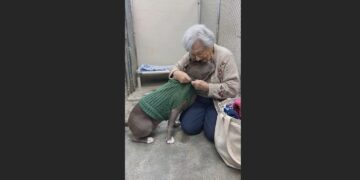









Rocky had spent all ten years of his life with one family. He knew the people he lived with, and whatever his days had been like, their home was the only one he had ever known. Then, when he was a senior dog, that life came to an abrupt end.
His family took him to a large public animal shelter in Texas. Their explanation was simple: Rocky was “too old.” Before leaving, they asked the staff to euthanize him.

The shelter workers refused. They saw an aging dog who needed help, but they did not believe his life was over. In May 2018, when The Dodo shared Rocky’s story, that decision had already given him something he might otherwise have lost: the chance to spend his remaining years with people who wanted him.
Being ten years old may make a dog a senior, but it does not tell us everything about the life he can still enjoy. Rocky would soon show just how much curiosity, affection, and quiet enthusiasm he had left. First, though, someone had to get him through the bewilderment of losing the only family he knew.

At the shelter, Rocky seemed to withdraw into himself. He was gentle with the people caring for him, yet he appeared confused and defeated. The staff were concerned about how completely he had shut down. A busy shelter is a difficult adjustment for many dogs, and Rocky was facing it after a decade in one home.
There was no way to ask him what he understood about being left behind. Kathy Fridley, who would later become his foster mother, imagined that he might have been waiting patiently for his family to come back. She told The Dodo that he probably did not realize they were gone for good.
It is a painful thought precisely because it is so ordinary. Dogs learn the small patterns of our lives: when someone goes out, when the household grows quiet, when familiar footsteps return. Rocky had no way of knowing that this departure was different. All the shelter workers could see was a sweet older dog who needed far more than a kennel and a meal.
They also knew his recovery might require specialized care. So they reached out to Shenandoah Shepherd Rescue, an organization based in Virginia, to ask whether it could take him. The rescue agreed. Rocky was transferred from Texas to Virginia and placed in a foster home, where his new caregivers could begin addressing both his medical needs and his fear.
The veterinary concerns were significant. Rocky was roughly twenty pounds underweight. He needed treatment for allergies, flea dermatitis, and heartworm disease. He was also nervous around other dogs. None of these problems could be resolved simply by telling him that he was safe now. His caregivers had to help him recover at a pace his body and temperament could manage.
For an older dog, those details mattered. A comfortable home was important, but so were appropriate treatment, steady meals, and adults willing to pay attention to how he was doing. Caring for Rocky meant seeing the whole dog: not only his age or medical chart, and not only the circumstances of his surrender, but the personality that began to emerge once he had a little stability.

Fridley came to know him as an exceptionally mild-mannered companion. He did not bark much, if at all, during the time she described. He did not chew up things around the house, and he was reliable about not having accidents indoors. These are the sorts of details a foster parent notices in everyday life, often more revealing than a photograph or a short adoption profile.
But Rocky’s good manners were not the thing that touched her most. It was the way he responded to ordinary kindness.
When someone stopped to pet him, he would lean toward the person’s hand, accepting the attention with a tenderness Fridley found hard to forget. He did not seem demanding. He wanted to be close enough to enjoy a gentle touch, and he appeared content to stay there for as long as someone was willing to give it.
Fridley believed he had received very little affection in his earlier years. No one outside his former household could know every part of Rocky’s past, but his condition and reserved behavior made her wish she could have known him before life had worn him down. What she could offer now was patience, a place to rest, and the simple reassurance of being included.
Even toys were something of a discovery. According to Fridley, Rocky had not really been accustomed to them. At first, he needed time to figure out what to do with one. Eventually, he began to chew on toys gently. It was a small development, easy to overlook beside the larger story of his rescue, but it revealed something important: he was still interested in learning.

Walks became one of those pleasures. He liked getting outside and exploring, and his foster mother described him as having more energy than people might expect from a ten-year-old dog with his history. The same dog who had seemed so defeated at the shelter was eager to see what was beyond the house.
He also enjoyed quieter times. Sitting out on the porch with his foster family suited him just fine. Rocky did not need constant excitement to be happy; being near kind people was often enough. He could enjoy a walk and then settle into the rhythm of an ordinary day. For someone hoping to share a home with a calm companion, that balance was one of his loveliest qualities.
And then there were the car rides.
Fridley said Rocky adored them. He seemed to brighten when he rode in the back seat, looking through the window as the world passed by. After everything he had endured, it was encouraging to see him respond so happily to an experience as simple as going for a drive. He was not a dog who had lost all interest in life. He was a dog whose interest was becoming visible again.
Of course, his progress did not mean every difficulty had disappeared. Rocky remained uneasy around other dogs, and Fridley was working with him on that fear. Some days were better than others, but she saw him gradually improve. He kept trying, even when he was unsure.
That was another reason his next home would need to be chosen carefully. A family could not reasonably expect him to arrive with every worry behind him, particularly after the disruption he had experienced. He would need people who understood that an older rescue dog can be loving and well behaved while still requiring time, guidance, and consistency.
Shenandoah Shepherd Rescue and Fridley had a clear picture of the household that might suit Rocky best. Ideally, someone would be home for a good portion of the day. He enjoyed company and wanted to take part in family life rather than spend most of his time alone. Regular walks, attention, and those much-loved car rides would make his days especially pleasant.
Rocky was good with children, but a home without very young kids was considered the better match. He would also prefer to be the only pet. Living with another calm dog might be possible, provided his adopters were prepared to continue helping him grow more comfortable. Those preferences were not flaws to excuse. They were useful things to know about a dog who deserved to be placed where he could succeed.
A lasting home for Rocky would mean people who saw his gentle nature before they saw his gray years. People who understood that medical care and patience were part of loving him, not reasons to turn away. People who were happy to take him on an afternoon drive, sit beside him on the porch, or stop what they were doing for a few minutes because he had quietly come over for attention.
Fridley was not looking for a family who would pity Rocky. She wanted one that recognized what a good companion he already was. Speaking to The Dodo, she said she hoped someone would understand how special he was and make his final years wonderful. She could not change what had happened to him before, she explained, but she was grateful that he now had the possibility of a happier future.
Rocky’s story was not a tale of a dog suddenly transformed into someone else. The calm, trusting, gentle qualities his foster mother loved may have been there all along. What changed was that he found people who noticed them. They saw a dog worth caring for even when he was frightened, underweight, and far from the playful puppy stage that tends to draw attention.
At the time his story was published, Rocky was in foster care and the search for a permanent family was still part of his journey. The original account did not establish that he had already been adopted, so his ending should not be rewritten as a reunion or a guaranteed happy placement. What it did establish was something meaningful in its own right: he had been given care, safety, and another chance.
The people at the Texas shelter could have accepted his former family’s request. Instead, they recognized that age alone was no reason to end his life. A rescue in Virginia answered their call. A foster mother welcomed him, treated his needs seriously, and came to appreciate the quiet company of a dog others had decided was too old.

And Rocky, in turn, kept showing them who he was. He learned to enjoy a toy. He went for walks. He rested with his people. He leaned into a gentle hand and looked out the car window with the pleased attention of a dog who still found the world interesting.
For Rocky, the most important thing about the years ahead was never going to be how many there were. It was whether those years would be spent with people who were glad he was there.
If Rocky’s story stays with you, consider sharing it with someone who has a soft spot for senior dogs. Older animals still have so much companionship to give, and they deserve the chance to give it.







Discussion about this post