












For weeks after I adopted Barnaby, he wouldn’t eat if I stayed in the room. He slept in the darkest corner of my living room, ignored the comfortable bed I’d bought him, and seemed determined to keep his distance.
Then, one rainy morning, I heard his nails moving across the hardwood floor.
I turned around and found him standing in the kitchen doorway.
He looked at me for a moment, walked slowly across the room, and settled beside my feet.
It was the first time he had voluntarily come to sit with me.
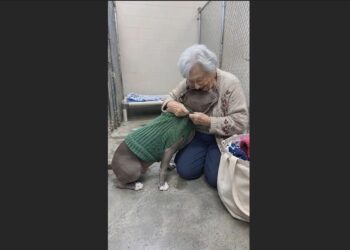
I was 71 years old when I adopted Barnaby, a 13-year-old Pit Bull who had spent two years at an animal shelter. Neither of us had been doing particularly well before we met.
I had lost my wife. Barnaby had lost the man who had been his family for eleven years.
And while I had gone to the shelter hoping to find a cheerful young dog who might make my house feel less empty, I came home with an elderly companion who needed just as much patience as I did.
The Loneliness That Brought Me to the Shelter
My name is Arthur Pendelton.
For most of my adult life, I had been a craftsman, a husband, and a father. My days were filled with work, family responsibilities, and the ordinary routines that make a life feel settled.
Then my wife died.
Two years passed, but I still struggled with the absence she had left behind.
Our children had grown up and built their lives in other parts of the world. I was proud of them, of course, but their distance meant that most days I was alone in the house my wife and I had once shared.
I missed the small things more than I expected.
I missed hearing her moving around the house. I missed the songs she used to hum while we worked together in the garden. I missed having someone to talk to about matters that wouldn’t have interested anyone else.
The house hadn’t changed much. The furniture was still there, and the garden still needed tending.
But the everyday companionship that had made those things meaningful was gone.
Eventually, I began thinking about adopting a dog.
I imagined a young, friendly animal who would enjoy walks, follow me around the garden, and give me a reason to get up each morning with something pleasant to look forward to.
I wasn’t expecting a dog to replace my wife. Nothing could do that.
I simply wanted another living creature in the house.
So one morning, I went to an animal shelter.
I thought I knew what kind of companion I was looking for.
I was wrong.
The Old Pit Bull Nobody Expected Me to Choose
A volunteer named Elizabeth showed me around the shelter.
There were younger dogs who seemed delighted by the attention. Some barked excitedly, while others approached their kennel doors hoping for a chance to meet someone new.
But Elizabeth eventually led me toward a quieter area.
At the back of one kennel was an elderly Pit Bull named Barnaby.
He was thirteen years old.
For two years, he had lived at the shelter, spending much of his time withdrawn in a corner.
Before that, he had spent eleven years with a man who had loved and raised him.
Whatever the circumstances that separated them, Barnaby had struggled terribly with the loss of his familiar life.
He showed little interest in playing or approaching people. Rather than moving toward visitors, he preferred to remain in his quiet corner.
I stood watching him for a while.
He wasn’t the energetic young dog I had imagined bringing home.
He was older, reserved, and clearly having difficulty with his circumstances.
But something about him made me stay.
I knew what it was like to live in a place that had lost its familiar warmth. I knew how exhausting it could be to face another day without the person who had once been part of every routine.
I couldn’t know whether Barnaby experienced grief in the same way I did.
Still, I recognized that he had lost something important.
And I began wondering whether we might be able to offer each other a little companionship.
The Decision That Surprised the Shelter Staff
When I told Elizabeth that I wanted to adopt Barnaby, she looked surprised.
She knew his history at the shelter and wanted to make certain I understood the responsibility I was considering.
She approached me gently but spoke with unmistakable seriousness.
“Arthur, this is a wonderful decision, but you need to understand what you’re taking on. He may never come running to greet you. He might never want to play, wag his tail, or even look you in the eye.”
I listened carefully.
Elizabeth wasn’t trying to discourage me out of unkindness. She was being honest about a dog who had spent two years showing very little interest in people.
She didn’t want me to take him home expecting an affectionate companion who would immediately settle into family life.
Barnaby might require a great deal of patience.
And there was no guarantee that he would ever become the sort of dog I had originally imagined adopting.
I understood her concern.
But I had spent two years struggling to find my own way through a difficult loss.
I knew that being rushed toward happiness wasn’t always helpful.
I looked at Elizabeth and told her:
“I understand. My house is empty, too, and I have memories that are still difficult to live with. Maybe we can give each other time.”
That was enough for me.
I completed the adoption paperwork and prepared to take Barnaby home.
I wasn’t expecting him to transform overnight.
I just wanted him to have somewhere peaceful to spend his later years.
And perhaps, in looking after him, I would find a little more purpose in my own.
Bringing Barnaby Home Was Only the Beginning
When I opened the back door of my car, Barnaby approached slowly.
He climbed onto the seat without resisting, then settled down and turned his muzzle toward the window.
During the drive, he remained almost completely still.
I spoke to him occasionally, hoping the sound of my voice might become familiar.
At one point, I found myself humming the old songs my wife used to enjoy when we gardened together.
Barnaby didn’t respond.
He simply watched the scenery passing outside.
I didn’t know whether he was frightened, exhausted, or merely uncertain about another change in his surroundings.
Whatever he was feeling, I decided to leave him in peace.
When we reached my house, he stepped out of the car and looked around.
He stood in the driveway for a while before moving toward a quiet corner near the old stone well.
Then he sat down.
I remember that moment clearly because it was the same place where I had often gone to sit alone after my wife’s death.
On difficult evenings, I would settle there, away from the windows, and allow myself a little privacy.
Now Barnaby had chosen it.
I didn’t imagine that he understood the significance of the place.
But seeing him sitting there made me feel an unexpected tenderness toward him.
Perhaps we both preferred somewhere quiet when the world felt difficult.
The Bed He Refused to Use
Before bringing Barnaby home, I had prepared a comfortable sleeping area in the living room.
There was a large, soft mattress made with thick wool, and I hoped he would enjoy having a warm place of his own.
He barely acknowledged it.
Instead, he settled directly onto the floor in the darkest corner of the room.
I considered encouraging him toward the bed, but something about his behavior made me hesitate.
He had already experienced enough change.
If sleeping in that corner helped him feel more comfortable, I could let him have it.
That first night, I couldn’t sleep either.
I sat in my old leather armchair across the room while Barnaby rested on the floor.
Occasionally, our eyes met.
He didn’t bark or whine. He made no attempt to approach me.
And I didn’t try to force a connection.
We simply spent the evening in the same room.
It wasn’t the companionship I had pictured when I first decided to adopt a dog.
But it was a beginning.
Learning That Trust Cannot Be Rushed
The first several weeks taught me how much patience Barnaby needed.
He was especially uncomfortable eating when I was nearby.
If I remained in the room after putting down his food, he would turn his head away and stay motionless.
The same thing happened when I approached his water bowl.
He wasn’t being stubborn.
He seemed unable to relax enough to eat or drink while someone was watching him.
So I changed my routine.
Each morning and evening, I placed his food near the corner where he preferred to rest. I spoke a few quiet words, then left him alone.
Once I had stepped into another room and closed the door, I would hear him get up and approach the bowl.
He ate when he felt he had enough privacy.
I couldn’t know what experiences had led to that behavior, and I didn’t want to make assumptions about his previous owner.
All I knew was that Barnaby needed space.
So I gave it to him.
I stopped expecting him to behave like the affectionate young dog I had originally wanted.
Instead, I began paying attention to the dog actually living in my house.
The Afternoons We Spent Together
Although I respected Barnaby’s need for distance, I also wanted him to become comfortable with my presence.
I began spending part of each afternoon sitting near him.
I would make myself a cup of tea, bring a wooden chair into the room, and place it far enough away that he didn’t feel cornered.
Then I would talk.
Sometimes I told him about my younger years and the work I had done as a craftsman.
Other afternoons, I spoke about my children and the lives they had built so far away.
Most often, though, I talked about my wife.
I remembered the things she used to say, the songs she loved, and the ordinary experiences I still missed sharing with her.
I didn’t expect Barnaby to understand the stories.
In truth, I wasn’t sure how much attention he was paying.
Sometimes his eyes were half-closed. Other times, he stared toward the wall.
But I noticed that his ears would occasionally move when the tone of my voice changed.
He was listening, at least in his own way.
And I found that speaking aloud made the afternoons easier for me, too.
For two years, I had spent far too much time alone with my thoughts.
Now I had someone to talk to, even if that someone preferred to listen from a corner of the room.
I wasn’t asking Barnaby to make me happy. I was simply learning how to share my days with him.
The Rainy Morning Everything Began to Change
At the beginning of our second month together, something happened that I hadn’t expected.
It was a rainy morning, and I was in the kitchen preparing coffee.
I heard the faint sound of claws against the hardwood floor.
At first, I assumed Barnaby was moving around in the living room.
Then I turned.
He was standing in the kitchen doorway.
For several seconds, I hardly moved.
Barnaby looked directly toward me.
He wasn’t trembling or pressing himself against a wall.
Then he began walking.
Slowly, he crossed the kitchen and came to sit beside my feet.
He didn’t ask for food.
He didn’t push his head beneath my hand or demand affection.
He simply chose to sit near me.
It was such a small thing, yet after weeks of watching him avoid my presence, I understood how significant it was.
I remained still, allowing him to decide how close he wanted to be.
For the first time since his adoption, Barnaby seemed comfortable sharing a small space with me.
I didn’t want to spoil the moment by making too much of it.
So I continued with my morning, quietly enjoying his company.
From then on, he began joining me regularly while I ate breakfast.
It became our first shared routine.
And after weeks of wondering whether Barnaby would ever feel comfortable around me, I found myself looking forward to those peaceful mornings more than anything else.
The Day I Took Barnaby Back to the Countryside
About two months after that first visit to the kitchen, Barnaby had become noticeably more settled.
He still preferred a quiet life, but he was no longer spending all his time withdrawn in a corner.
I began thinking about something I could do for him.
Before arriving at the shelter, Barnaby had known a different kind of home. I wondered whether he might enjoy spending time somewhere open and peaceful.
I rented a small piece of agricultural land outside the area where I lived, surrounded by grassy fields and natural vegetation.
One day, I decided to take him there.
Barnaby climbed into the car, and we drove out toward the countryside.
When I stopped at the end of the dirt road, he lifted his head.
I watched him take in the unfamiliar surroundings.
There was open land ahead of us, with tall grass and room to move.
When I opened the car door, he stepped down carefully.
For a moment, he stood still.
Then something remarkable happened.
Barnaby started running.
The Run I Will Never Forget
It wasn’t the easy, effortless movement of a young dog.
Barnaby was thirteen, and his joints had become stiff with age.
His stride was heavy, and he didn’t move with the speed he might once have had.
But he was running.
He crossed the grass with his ears moving in the breeze, putting distance between himself and the car.
I stood watching, hardly believing what I was seeing.
This was the same dog who had spent two years withdrawn in a shelter kennel.
The same dog who had refused to eat in my presence.
The same dog who had spent his first weeks in my home sleeping on the floor in a dark corner.
And now he was moving across an open field, apparently enjoying himself.
I couldn’t know what memories the place might have stirred or whether it reminded him of anything from his earlier life.
But I could see that he wanted to run.
After roughly a hundred yards, he stopped.
Then he turned and looked back toward me.
He waited.
I walked over to him and lowered myself to my knees in the grass.
For the first time, I opened my arms without worrying that he might immediately turn away.
Barnaby took a couple of steps toward me.
Then he leaned against my chest and lowered his large head into the space between my shoulder and neck.
I put my arms around him.
He stayed there.
I had spent months allowing Barnaby to decide when he was ready for contact. Now, in the middle of that field, he had come to me willingly.
I won’t pretend I remained completely composed.
I cried.
Not because I believed all his difficulties had suddenly disappeared, but because I knew how much patience it had taken for us to reach that moment.
He had trusted me enough to come close.
And I was deeply grateful.
A Different Life, One Small Step at a Time
The visit to the countryside didn’t turn Barnaby into a young dog again.
He was still thirteen, with an aging body and years of experience behind him.
But afterward, I began noticing more changes in his behavior.
When I returned from shopping, he sometimes greeted me with a wagging tail.
He discovered an old leather ball in the garden and began bringing it to me.
The first time he placed it near my knees, I found myself remembering Elizabeth’s warning at the shelter.
She had told me Barnaby might never want to play.
Now he was bringing me a toy.
Those moments mattered because they were entirely his choice.
I’d never required Barnaby to become outgoing or affectionate.
I had simply given him a home and the opportunity to become comfortable in it.
Gradually, he began showing me more of his personality.
At night, he no longer chose the dark corner of the living room.
Instead, he settled at the foot of my bed.
It became another familiar routine.
I could hear him breathing quietly as I fell asleep, and I found the sound reassuring.
After so many nights alone in that house, having him nearby made a difference.
Two Years Later, We Still Have Each Other
Barnaby is fifteen now.
His muzzle has grown noticeably whiter, and he moves more slowly than he did when I first brought him home.
There are days when his age is especially apparent.
But he still enjoys our quiet routines.
Each morning, he comes to the side of my bed and rests his head near me.
In the evenings, we take a slow walk around the garden.
And at night, he settles close enough that I can hear his breathing.
We don’t need much excitement to enjoy being together.
I know Barnaby had an important life before he met me.
For eleven years, another man loved and cared for him. That history will always belong to Barnaby, just as my years with my wife will always belong to me.
I have never wanted to erase his past.
And I no longer expect myself to forget mine.
There was a time when I worried that feeling happy again somehow meant leaving my wife behind.
Living with Barnaby has helped me understand that the memories I cherish don’t have to disappear for new companionship to become meaningful.
My wife will always be part of my life.
Barnaby’s first owner will always be part of his story.
But we are here now, sharing the years we still have.
And that is something worth appreciating.
The Dog I Never Expected to Bring Home
When I first walked into the shelter, I was looking for a young dog who could bring some activity back into my life.
I imagined walks, games, and an energetic companion who would keep me busy.
Instead, I found Barnaby.
He was an elderly Pit Bull who had spent two years avoiding people, uncertain whether he could ever feel comfortable in another home.
I brought him home knowing he might never become particularly playful or affectionate.
For weeks, he barely acknowledged me.
But slowly, we developed a life together.
He learned that I would give him space when he needed it.
I learned that his quiet presence could be enough.
And over time, he began choosing to spend more and more of his day near me.
Looking back, I don’t think our friendship was built in one remarkable moment.
Not even the day he ran through the field.
It grew through ordinary mornings in the kitchen, afternoons when I sat nearby talking, and quiet evenings when neither of us needed anything more than company.
Barnaby didn’t have to become a different dog to make my life better. And I didn’t have to stop missing my wife to welcome him into it.
I went to the shelter hoping to find someone who would make my house feel less empty.
What I found was an older companion who needed a peaceful home, time, and someone willing to accept him as he was.
Today, when Barnaby rests his gray muzzle beside my bed or waits for me in the garden, I am reminded of how much those small moments have come to mean.
At seventy-one, I thought I needed a young dog to bring life back into my home.
Instead, a thirteen-year-old Pit Bull taught me that companionship doesn’t always arrive with excitement or enthusiasm.
Sometimes it arrives quietly, keeps its distance for a while, and gradually learns that it is welcome.
Barnaby and I have both grown older since the day we met.
Our walks are slower now, and we spend more time resting than we once did.
But the house no longer feels quite so empty.
There is someone waiting when I come home.
And each morning, when I wake to find Barnaby standing beside my bed, I have another reason to be grateful for the day ahead.






Discussion about this post