













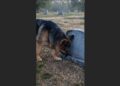
Every morning at sunrise, a German Shepherd appeared at a cemetery in Texas and walked to the same grave.
He never seemed interested in the other headstones. He didn’t wander through the grounds looking for attention, and he rarely allowed anyone to approach him.
Instead, he went directly to one particular resting place, settled down, and remained there for approximately an hour.
Then he quietly left, heading toward a nearby neighborhood.
The cemetery workers noticed the routine because it happened so consistently. Whether the morning was hot, rainy, or bitterly cold, the dog returned to the same spot.
According to the account, he continued doing this for three years.
No one at the cemetery knew his name. Nobody had reported him missing to the staff, and the employees couldn’t understand why he kept visiting the same grave.
They tried approaching him, hoping to check for identification or scan for a microchip.
But the German Shepherd always moved away before they could get close enough.
He wasn’t aggressive. He simply seemed determined to keep his distance.
For three years, his visits remained a mystery.
Then, one morning in March, a woman arrived at the cemetery to visit another grave.
When she saw the dog, she stopped.
She recognized him immediately.
And as she looked toward the headstone beside him, she began to cry.
A Quiet Visitor Who Never Missed His Morning Routine
The groundskeeper had become accustomed to seeing the German Shepherd.
At first, the dog’s presence may have seemed like an ordinary visit from an animal wandering through the neighborhood.
Dogs sometimes enter cemeteries while exploring, especially if they live nearby. But this visitor behaved differently.
He wasn’t searching the grounds.
He appeared to have a destination.
Each morning, he made his way to the same headstone and remained there for almost exactly an hour.
Afterward, he left.
The routine was so predictable that cemetery employees began recognizing him as part of their mornings.
His arrival didn’t seem to depend on the weather or the presence of other visitors.
Even when the conditions were unpleasant, he reportedly continued coming.
What puzzled the staff most was that nobody accompanied him.
They didn’t see an owner walking him on a leash or waiting nearby. He appeared alone and left the same way.
The workers wanted to know whether he belonged to someone.
One employee explained that they had tried getting close enough to check for a microchip.
“Every time we got near, he’d quietly slip away before we could reach him.”
The dog didn’t bark or threaten them. He simply moved away and avoided being handled.
Eventually, the workers learned to give him space.
They could see that he was repeatedly returning to one particular grave, but they had no information connecting him to the person buried there.
And for a long time, there seemed to be no way to find out.
Three Years of the Same Unanswered Question
As the months passed, the German Shepherd’s routine became increasingly difficult to explain.
An occasional visit might have been dismissed as coincidence.
But a dog returning to one location day after day for years suggested that something about the place was familiar or important to him.
The groundskeeper reported that the behavior remained remarkably consistent.
The dog arrived around sunrise, stayed for approximately an hour, and then returned toward the neighborhood.
That pattern continued through changing seasons.
The cemetery staff could observe what he did, but they couldn’t know why.
Animals can develop strong attachments to familiar locations, people, and routines. Certain places may also become associated with experiences that matter to them.
But without knowing this dog’s history, the workers couldn’t establish what his behavior meant.
They didn’t know whether someone had once brought him there or whether he had found the cemetery on his own.
They only knew that he kept coming back.
The answer would finally arrive through someone who remembered the dog from another part of his life.
The Morning a Woman Recognized Him
One morning in March, a woman visiting the cemetery noticed the German Shepherd sitting beside the familiar headstone.
She hadn’t come looking for him.
But the moment she saw him, she knew who he was.
His name was Ossie.
And the grave he had been visiting belonged to her father.
Her father was a military veteran who had died three years earlier.
During his lifetime, Ossie had been his service dog.
The two had shared the close relationship that can develop between someone who relies on a trained companion and the animal who works beside them.
After her father’s death, however, the family had been unable to keep Ossie.
They arranged for a neighbor to take him in.
As far as the woman knew, Ossie had been living with that neighbor ever since.
She had no idea he had been coming back to her father’s grave.
Standing in the cemetery that morning, she began to understand what the employees had been witnessing for years.
The mysterious German Shepherd wasn’t a stray visiting an unfamiliar burial ground.
He was a dog who had once belonged to the man buried beneath that headstone.
And somehow, he had continued finding his way back.
A Companion From Her Father’s Life
For the daughter, recognizing Ossie brought together two parts of her father’s memory.
There was the grave she could visit, and there was the dog who had once been part of her father’s everyday life.
Until that moment, she hadn’t known those two connections were still meeting at the cemetery.
Her family had made arrangements for Ossie after her father’s death because they couldn’t care for him themselves.
That decision hadn’t erased the dog’s earlier relationship with his handler.
Nor had it necessarily erased the routines and places he remembered.
The daughter explained that Ossie had lived with a neighbor since her father passed away.
She was astonished to discover that he had apparently been leaving that home to visit the cemetery.
The staff’s observations suggested he had been doing so for approximately the same length of time since her father’s death.
The timing made the discovery especially emotional.
The German Shepherd the employees had watched for three years was no longer an unknown visitor.
He was part of someone’s family history.
The Neighbor Had Been Wondering Where Ossie Went
After recognizing Ossie, the daughter contacted the neighbor who had taken him in.
The neighbor confirmed something that helped explain the cemetery visits.
Ossie had been disappearing regularly.
He would leave home and later return, but the people caring for him hadn’t known where he was going.
They had tried different ways to prevent him from wandering off.
Those efforts hadn’t stopped the behavior.
According to the neighbor, Ossie kept finding opportunities to leave.
“We had no idea where he was going.”
The discovery at the cemetery finally provided an answer.
Ossie wasn’t simply roaming without an apparent destination.
He had been traveling to the grave of the person he once served.
The account doesn’t explain how far he walked or how he originally learned to reach the cemetery.
It also doesn’t establish whether his former handler had ever taken him there before his death.
Those details remain uncertain.
What the story describes is a consistent connection between Ossie’s unexplained absences and the cemetery workers’ observations.
For years, the neighbor had known that the German Shepherd was leaving.
For years, the cemetery staff had known that a German Shepherd was arriving.
Neither understood the complete situation until the daughter recognized him.
Two Separate Mysteries Finally Had an Answer
There is something striking about how long the situation continued without anyone connecting the pieces.
At the cemetery, the staff saw a dog who seemed to have a particular destination.
At home, the neighbor saw a dog who seemed determined to leave.
Both were observing the same routine from different ends.
But neither had the information needed to understand it.
The daughter’s recognition brought those separate observations together.
For her, the discovery also meant realizing that Ossie had maintained a connection with her father’s resting place long after the family had arranged another home for him.
She couldn’t know exactly what the dog understood about his former handler’s death.
But she knew the relationship they had shared.
And she could see where Ossie had been spending his mornings.
For the First Time, Ossie Sat Beside Her
The most personal moment in the account came after the daughter approached her father’s grave.
She knelt beside the headstone.
Ossie, who had consistently avoided the cemetery workers, slowly moved toward her.
Then he sat down beside her.
For the people who had spent years trying unsuccessfully to approach him, the behavior was unusual.
Ossie had always kept his distance from unfamiliar hands.
This time, he came close voluntarily.
The daughter remained beside her father’s grave, with the German Shepherd sitting next to her.
It was a quiet reunion, but a meaningful one.
She had recognized a dog who had once been part of her father’s life.
And Ossie had approached someone connected to the family he had known.
Whether he recognized her immediately, responded to her familiar presence, or simply felt comfortable approaching her cannot be determined from the account.
What mattered was what happened.
For the first time the cemetery staff knew of, the dog who had guarded his distance from visitors willingly sat beside someone.
They stayed together at the grave of the man they had both known.
No elaborate gesture was needed.
The moment carried its own significance.
A New Routine for Ossie and the Veteran’s Daughter
After the discovery, the daughter and Ossie’s current caregiver began making arrangements to visit the cemetery together.
Rather than leaving the German Shepherd’s visits entirely unexplained, they now understood where he wanted to go.
According to the story, the neighbor and daughter began bringing him to the cemetery once a week.
During those visits, Ossie continued settling beside the same grave.
He remained there for about an hour, much as he had during his earlier visits.
The difference was that he now had people accompanying him.
The account doesn’t clarify whether his independent daily trips stopped completely after the family discovered his destination.
What it does describe is the new shared routine: Ossie could visit the cemetery with people who knew his history and understood the importance they attached to that place.
For the daughter, those visits offered a way to spend time remembering her father while remaining connected to the dog who had once served him.
For Ossie, they preserved a familiar destination within a safer, more supervised arrangement.
The cemetery was no longer a mystery to the people caring for him.
And the daughter had gained an unexpected connection to her father’s memory.
The Small Stick Beside the Headstone
One detail in the story is particularly memorable.
The family describes Ossie arriving at the grave on the veteran’s birthday with a small stick in his mouth.
He reportedly places it beside the headstone.
It is a simple behavior, but one the family has come to regard with affection.
There is no way to know whether Ossie understands the date or associates it with his former handler.
Dogs don’t recognize calendar anniversaries in the way people do.
They can, however, remember familiar routines and develop associations with people, places, and experiences.
Whatever explanation lies behind the behavior, the daughter sees a reminder of the bond Ossie once shared with her father.
The stick isn’t an elaborate tribute.
It’s an ordinary object carried by a dog and placed near a familiar resting place.
But for a family remembering someone they loved, even a small gesture can become meaningful.
What Ossie’s Visits May Tell Us About the Bonds Dogs Remember
Dogs form relationships through years of repeated experiences.
They become familiar with the people who feed them, care for them, spend time with them, and provide stability in their lives.
For a service dog, the relationship with a handler may include an especially close daily routine.
The dog learns to respond to the person’s needs and work alongside them.
That doesn’t mean a dog understands every part of human life or loss.
But it does mean a person can become deeply familiar and important to the animal.
Ossie’s reported behavior suggests that his former handler’s resting place had become part of an enduring routine.
Exactly why he continued visiting cannot be known.
Perhaps he associated the cemetery with his handler. Perhaps a familiar scent, previous experience, or learned route contributed to the behavior.
The available story doesn’t establish those details.
And it would be misleading to claim that Ossie consciously understood death in the same way the daughter did.
Still, the observations described in the account are moving.
A German Shepherd repeatedly returned to one grave.
The person buried there had once been his handler.
And when the man’s daughter recognized him, she discovered that the dog had apparently maintained those visits for years.
The emotional meaning doesn’t require pretending we know every thought in Ossie’s mind.
The relationship between the dog and his former handler had clearly mattered to the family.
Now, Ossie’s behavior had given them another way to remember it.
Three Years Later, Ossie Still Has a Place to Visit
Ossie’s story begins with a mystery.
Cemetery workers noticed a German Shepherd appearing every morning, staying at the same grave for approximately an hour, and leaving without allowing anyone to approach.
For three years, they didn’t know his name or where he belonged.
Then a woman recognized him.
He had once been the service dog of her late father, a military veteran buried at the very grave Ossie continued visiting.
The neighbor caring for him had been wondering where he disappeared to each day.
The daughter had no idea her father’s former companion was returning to the cemetery.
The discovery brought those people together around a dog whose behavior had quietly puzzled them for years.
It also changed the way Ossie’s visits were handled.
Now, according to the account, the daughter and neighbor bring him to the cemetery together.
He still settles beside the headstone, and the family continues honoring the connection he shared with his former handler.
There is no need to claim that Ossie knows exactly what the grave represents.
Nor is it necessary to imagine that he has been deliberately performing a memorial ritual.
The more grounded details are meaningful enough.
He had a relationship with someone who was no longer there.
He repeatedly returned to the place where that person was buried.
And when the man’s daughter found him, he approached and sat beside her.
For the daughter, that must have been an extraordinary way to encounter a part of her father’s life again.
She went to the cemetery expecting to remember someone she had lost.
Instead, she found the dog who had once been his companion.
And together, they sat beside his grave.
Ossie could no longer spend his days with the man who had cared for him. But through those visits, he remained connected to a place that had become familiar to him.
For the family, that quiet connection was worth preserving.
So they continued bringing him back.
And when Ossie settled beside the headstone, they let him stay for a while.
Just as he always had.








Discussion about this post