










Yesterday, I was making dinner when I heard a sound from the living room that I know far too well.
It was Buster, my 16-year-old Lab mix, crying for help.
I didn’t have to see him to suspect what had happened. These days, Buster sometimes walks into a narrow space, gets confused, and cannot work out how to turn around. His body may be perfectly capable of backing away, but in that moment, the simple way out seems to disappear from his mind.
I was about to stop what I was doing and go to him. Before I could even wipe my hands, though, someone else reached him first.
Finn, our four-month-old Golden Retriever puppy, had heard him too.
What happened next was such a small, quiet act that I might have missed it if I hadn’t been paying attention. Yet I’ve been thinking about it ever since.
The Hard Part of Watching Buster Grow Old
I have been fortunate to share so many years with Buster. At sixteen, he has reached an age that is a gift in itself. I know that. I remind myself of it whenever I catch myself wishing things could be easier for him.
Buster has canine dementia, a condition that has made familiar parts of our home confusing for him. One of the hardest things to watch is the way he sometimes gets trapped in a corner or a tight gap. He will walk between the couch and the wall, then stand there as though the space has closed around him.
He doesn’t simply turn and leave.
Instead, he becomes frightened. His body shakes, and he starts to whine. The solution looks obvious from where I’m standing. All he needs is a little help finding the direction he can move. But what is obvious to me is no longer always obvious to Buster.
That is the part that hurts.
There was a time when I took his ability to move comfortably through the house for granted. I didn’t have to think about whether a familiar room would suddenly become a problem. Now I pay attention to things I once would never have noticed: where he is standing, whether he can turn, and whether a quiet moment might mean he’s having trouble.
I can’t stand beside him every second of the day. There are ordinary things that still need doing, and sometimes I am in another room when he gets confused. I can help him when I hear him, but I can’t prevent every frightening moment.
The worry has a way of following me, even when Buster seems settled. I know he isn’t being stubborn, and I know he isn’t choosing to stand there. He’s trying to make sense of something his mind no longer handles the way it used to.
I can love him fiercely and still be unable to fix that.
Then We Brought Home Finn
Finn is only four months old, a Golden Retriever puppy at the very beginning of his life. Buster is sixteen, living through the kind of changes that come with its far other end. When we brought Finn home, I wondered how those two stages of life would fit together.
Puppies have their own needs and energy. They want to explore, play, and discover what every new thing is for. An older dog who needs rest and patience may not always appreciate the attention of a youngster who hasn’t learned much about boundaries yet.
I didn’t bring Finn home expecting him to take care of Buster. That would have been an unfair responsibility to place on a puppy. I hoped they could share our home comfortably, and I knew it would be my job to pay attention to what Buster needed.
Still, Finn seemed to notice that our old boy was different.
I can’t say what a puppy understands about aging or illness. Finn certainly doesn’t know the medical name for what is happening to Buster. But there is a difference between understanding a diagnosis and responding to another animal’s behavior. From what I could see, Finn was learning how to be around Buster without demanding that Buster keep up with him.
That alone meant a great deal to me.
What I didn’t know was that the youngest dog in our home would soon offer Buster help in a moment I usually handled myself.
The Cry I Heard From the Kitchen
Yesterday’s incident began in the most ordinary way. I was preparing dinner in the kitchen, and Buster was in the living room.
Then I heard him whine.
It’s a sound that goes straight through me now. I know it can mean he’s caught somewhere and needs someone to help him figure out how to get free. I was ready to leave what I was doing, wipe my hands, and go to him.
But before I reached the room, Finn was already moving.
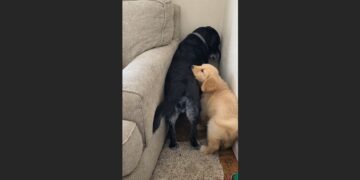
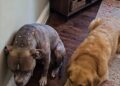
Our little Golden Retriever trotted over to the place where Buster had become stuck. The gap was narrow, between the couch and the wall, and Buster was standing there frightened and unsure how to get himself out.
Finn didn’t bark at him. He didn’t bounce around him or turn the moment into a game. He simply went close, as if the only thing that mattered was getting beside his old companion.
Then he squeezed his small body into the space next to Buster.
A Gentle Nudge in the Right Direction
What I watched was remarkably simple.
Finn began nudging Buster with his nose. Not hard. Not in a way that sent the older dog stumbling. He used small, gentle pushes, just enough to help Buster turn toward the open room.
Little by little, Buster changed direction.
And then he was facing the way out.
I don’t know whether Finn intended to guide him or was simply responding to his distress and the shape of the space around them. It would be easy to assign a complicated plan to a puppy when something like this happens. I don’t need to do that to appreciate what I saw.
Finn went to Buster when he was crying. He nudged him gently, and those nudges helped him turn around. Buster was no longer trapped.
Afterward, Finn gave him a quick lick on the nose.
Then, with the matter apparently settled as far as he was concerned, he wandered away to play with his toy.
There was no fuss and no lingering demand for attention. One moment Finn was helping Buster, and the next he was simply a puppy again.
That almost made the whole thing more touching to me. He hadn’t done anything for praise. He didn’t wait for me to notice or make a big production of what had happened. He gave Buster the help he seemed to need and went back to the business of being four months old.
Meanwhile, Buster stopped crying. He moved calmly out into the room and made his way back to his bed.
The Quiet That Came After
I stayed with that image: my old dog no longer frightened in the narrow gap, and my little puppy already occupied with his toy.
But I knew how often Buster struggled in places like that. I knew the sound of his crying, and I knew how helpless he could look when he couldn’t work out a simple turn. Seeing Finn respond so calmly was something I had not expected.
I felt relieved for Buster. And I felt grateful that, for those few moments when I wasn’t beside him, he hadn’t been alone with his confusion.
A Puppy Can’t Fix Dementia. But He Can Offer Comfort.
I want to be careful about how I tell this story, because Buster’s condition hasn’t disappeared. He’s still sixteen. He still has canine dementia. He will still need help, patience, and attention when the world around him becomes difficult to understand.
Finn is not a trained caregiver, and I wouldn’t expect a young dog to carry that responsibility. What happened yesterday doesn’t mean I can stop looking out for Buster or assume Finn will always know what to do.
But it changed the way I looked at the relationship forming between them.
What I hadn’t fully considered was that Finn might bring a kind of companionship Buster could enjoy on his own terms.
The puppy didn’t need Buster to run or wrestle with him in that moment. He didn’t ask him to behave like a younger dog. He met him where he was, in a narrow space beside the couch, and helped him find the open room again.
That was enough.
It didn’t turn back time. It didn’t erase a diagnosis. It was simply an act of gentleness between two dogs whose lives are at very different stages.
And because I love them both, it meant more to me than Finn could possibly know.
The Gift I Didn’t Know I Was Bringing Home
I can’t stop Buster from aging. I can’t promise he won’t get confused again. What I can do is keep helping him through those moments and make sure his life is filled with as much reassurance as I can give him.
Now there is Finn, too.
I brought home a four-month-old puppy expecting the ordinary work and pleasure of raising a young dog. I didn’t expect him to notice Buster’s distress so quickly, slip into a cramped space, or help him turn back toward the room.
I certainly didn’t expect him to finish with one little lick and then wander off to find his toy.
But that is exactly what happened.
When I think about Buster’s old age, I still feel the ache of watching him lose abilities he once had. Yesterday didn’t take that ache away. It gave me another memory to hold alongside it: my old boy finding his way out, with a little help from a puppy who had only just joined our family.
For now, that is a beautiful thing to be grateful for.




Discussion about this post