











The man came through the shelter doors angry, pulling a frightened pit bull mix behind him. The dog’s name was Blue. His body trembled as he struggled to keep up, and the man’s words were as harsh as his arrival.
“I’m bringing him back,” he said. “He’s aggressive. He bit me. Just put him down.”
I work at a county animal shelter. I’ve heard plenty of reasons people give when they return a dog, but there was something especially unsettling about watching Blue that Tuesday. The man was making an accusation that could have serious consequences. The dog, meanwhile, seemed overwhelmed by the place he’d been brought to.
At that moment, all we had was the man’s version of what had happened. It would take two more days before we heard another.
A Bite Report, and a Dog Who Wouldn’t Stop Shaking
Because a bite had been reported, we placed Blue in a quarantine kennel. It was not something we could simply ignore. When a dog is accused of biting someone, the circumstances matter, and the report can affect what happens next. I understood why the shelter had to take the allegation seriously, even though the scene had left me deeply uneasy.
Blue didn’t behave the way the man had described him in the lobby. He curled into a corner of his kennel and shook. He wouldn’t touch his food. Nothing in those first moments gave us a full picture of the dog he’d been at home, but the contrast between the man’s anger and Blue’s fear was hard to overlook.
I kept thinking about how quickly a few words could change the way people viewed an animal. Aggressive. He bit me. Those were the words now attached to Blue. We did not yet know what happened before the bite, where the dog had been, or what he might have been responding to.
That uncertainty was frightening in its own way. A dog cannot explain an incident in a shelter lobby. He cannot tell us whether he was startled, afraid, threatened, or acting for some other reason. We have to look for reliable information from the people involved and handle the animal responsibly in the meantime.
For Blue, the waiting happened inside a kennel, away from the home he knew. I couldn’t know what he understood about why he was there. I only saw that he was frightened, withdrawn, and unwilling to eat.
The accusation followed him into the shelter. I wished we knew more.
Two Days Later, Someone Came Looking for Blue
When the shelter opened on Thursday morning, a woman walked into the lobby wearing dark sunglasses. Her hands were trembling. As she came closer, I noticed a deep bruise on her cheek.
She wasn’t there to browse the kennels or ask about adopting a dog. She had come for one animal.
“Is Blue still here?” she asked.
I told her he was. I also explained that he had been placed in quarantine after a bite report and that the situation could affect his future. I didn’t want to give her false reassurance, and I had no reason yet to believe the report was inaccurate.
The explanation seemed to undo what little composure she had managed to hold together. She began to cry. Then she told me what she said had happened in her home.
“My husband was hurting me. He had me pinned to the floor. Blue jumped in to protect me. He bit his arm so I could escape. He saved me.”
I can still understand why that account changed the way I saw Blue’s return. The bite hadn’t been described to us as part of a violent confrontation. We had been told only that Blue was aggressive and had bitten the man who brought him in.
Now a woman with a bruised cheek was telling us that the same incident had allowed her to get away from her husband.
The Story Behind the Bite
Her account didn’t erase the bite. It gave it a context we hadn’t been told about. That distinction is important. An animal’s behavior still has to be assessed carefully, and a serious allegation should never be settled by appearances or emotion alone. But a report that describes what happened without describing what led up to it can leave out the most important part.
I thought back to the man demanding that Blue be put down. When he spoke, he had made himself sound like the person who needed protection from the dog. According to the woman standing before me, Blue had intervened while she was being hurt.
I couldn’t know everything that had happened inside that home. I hadn’t been there. And I couldn’t claim to know the man’s precise motive for bringing Blue back. But the woman’s account made me question whether the return had been driven by fear of the dog at all. It raised the possibility that Blue was being punished for interfering.
The detail I couldn’t shake was her insistence that he had given her the chance to escape. For her, Blue was not the threat. He was the reason she had been able to get away from one.
That didn’t make the situation simple. It made listening to her essential.
When Blue Saw Her Again
I went to the back of the shelter and brought Blue out to see her. He was still the same dog who had been trembling in the quarantine kennel. But the moment he saw the woman, his behavior changed.
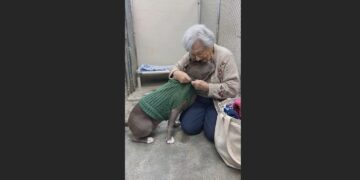
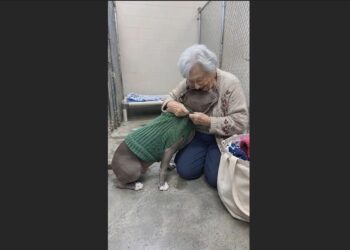
He let out a loud cry and moved across the floor toward her. When he reached her, he pressed close and wrapped his front paws around her. The fear that had seemed to hold him still in the kennel gave way, at least in that moment, to an urgent need to be near someone familiar.
I don’t have to guess what Blue was thinking to remember how powerful the reunion was. I could see him reach for her. I could see the way she had searched for him as soon as the shelter opened. Whatever else needed to be understood about the bite, their connection was unmistakable.
There are many ways dogs show attachment. Some approach quietly. Some wag their tails and lean against a person they recognize. Blue’s response was loud and physical, the opposite of the frightened stillness we’d seen after his arrival. Watching him with her made it harder to think of him only as a dog with an accusation attached to his name.
Of course, a reunion cannot settle a bite investigation on its own. Nor does one affectionate moment tell us everything about an animal’s behavior. But it can reveal something a file doesn’t contain: who the dog knows, who he seeks out, and how he responds when that person returns.
For Blue, the woman who had come looking for him was clearly someone he wanted to reach.
Leaving the Shelter Behind
Seeing them together didn’t answer every procedural question about a reported bite. The shelter’s responsibilities still mattered. But the day ended with something I had not expected when Blue first came through our doors: the woman packed her car and left the state with Blue beside her. I can’t speak to the details of how his quarantine was resolved. I only know that they were together when she left.
I don’t know where she went or what the months afterward looked like for either of them. I wouldn’t pretend that leaving a violent situation makes everything easy from that point forward. Safety, recovery, and a new beginning can require far more than a single courageous departure.
Still, I think about what that day represented for her. She came to the shelter with a bruise on her face and a frightening story to tell. She asked for the dog who, by her account, had helped her escape. Then she went on to the next part of her life with him at her side.
I also think about the risk that Blue’s story could have ended differently if no one had come to explain what happened. The words used in a report carry weight. So do the circumstances behind them. A frightened animal shouldn’t be declared harmless without careful assessment, but neither should he be judged only by the angriest person’s account.
More Than the Label He Arrived With
When the man returned Blue, he wanted us to see a dangerous dog. When the woman arrived, she described a dog who had acted while she was being attacked. Those two versions could not be treated as though they told the same story.
I won’t call every dog who bites a hero. That would be irresponsible, and it wouldn’t help the people or animals involved in difficult cases. What I will remember is how much we did not know when Blue first entered the shelter—and how important it was that another person came forward to tell us more.
I remember his trembling body in the quarantine kennel. I remember the woman in sunglasses, asking whether he was still there. And I remember the sound Blue made when he finally saw her again.
A bite was part of Blue’s story. It wasn’t the whole story.
What stays with me is the woman who found the courage to come back for him, and the frightened dog who crossed the floor to reach her. She said he had helped her get away when she needed him most. When she left, he was beside her.
For both of them, that was a beginning worth protecting.







Discussion about this post