




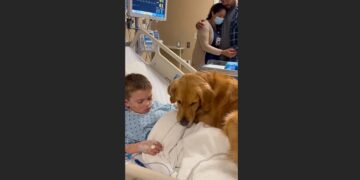









Matthew had spent so much time surrounded by hospital equipment, medical staff, and the constant uncertainty of waiting. When his golden retriever, Max, was brought to his bedside, nobody knew what to expect. Then, as the dog rested his head near the little boy’s chest, Matthew’s hand began to move.
Matthew lay quietly in his hospital bed, looking exhausted and terribly weak.
Medical monitors continued running beside him. Wires and equipment surrounded the bed, while his parents stood nearby, holding on to each other.
They had spent so much time in that room that its routines had become painfully familiar.
The lights. The sounds of the machines. The long stretches of waiting.
Every day, the people caring for Matthew were doing what they could to help him. His parents watched closely, hoping for some encouraging sign.
Then Max arrived.
The golden retriever didn’t rush toward the bed or become excited by the unfamiliar surroundings.
Instead, he approached slowly, moved close to Matthew, and gently rested his head near the boy’s chest.
He stayed there, calm and attentive.
For a little while, the hospital room felt different.
And then something happened that caught everyone’s attention.
Matthew’s hand began to move.
It was a small movement, but in a room where even the slightest change mattered, it was impossible to ignore.
His parents saw it.
The people standing near the bed noticed it too.
And through it all, Max remained beside the little boy.
A Hospital Room Filled With Waiting
For Matthew’s parents, watching their son struggle had become part of a difficult routine.
They were surrounded by people dedicated to helping him, yet there were still moments when all they could do was stand beside his bed and wait.
Hospital rooms can be difficult places for families, particularly when a child is seriously ill.
There are medical decisions to understand, unfamiliar sounds to get used to, and long periods when nothing seems to change.
Even when doctors and nurses are providing attentive care, parents may still feel helpless.
They want to comfort their child.
They want to know whether things are improving.
Above all, they want to see something familiar in the face of someone they love.
Matthew was still very weak when Max came to visit.
He wasn’t sitting up excitedly or reaching out to greet everyone.
He lay quietly, with the medical equipment continuing to monitor him.
His parents stood together in the background.
There was no indication that they expected anything extraordinary from the visit.
They were simply allowing a beloved dog to spend time near a little boy who had been through so much.
When Life Becomes Smaller Than It Used to Be
Before Matthew’s hospital stay, Max had been part of the world the boy knew.
The golden retriever represented something familiar from life outside the hospital.
That distinction mattered.
Inside the room, nearly everything revolved around Matthew’s illness and care.
The equipment was there for a reason. The people checking on him were doing necessary work. Every part of the environment had a purpose connected to his treatment.
But Max belonged to a different part of Matthew’s life.
He wasn’t a medical professional.
He couldn’t interpret a monitor or decide what treatment was needed.
He was simply a dog Matthew knew.
And sometimes, during a difficult experience, the presence of someone familiar can be comforting in ways that are hard to describe.
A child may not fully understand everything happening in a hospital.
But familiar voices, faces, and gentle companionship can still offer reassurance.
For Matthew, Max brought a connection to the life he had known before the hospital became such a large part of it.
The golden retriever couldn’t change the medical situation, but he could offer something deeply personal: his presence.
Max Approached the Bed Without Making a Sound
There was something particularly touching about the way Max behaved when he reached Matthew.
He didn’t jump around or demand attention.
He approached carefully.
Then he moved close enough to rest his head near the little boy’s chest.
It was a simple gesture.
Max wasn’t performing a dramatic trick or trying to entertain anyone.
He was doing something many dogs do naturally with people they trust: staying close.
The difference was the setting.
Matthew wasn’t sitting comfortably at home.
He was lying in a hospital bed, surrounded by equipment, looking worn out and barely moving.
Max seemed content to remain beside him.
The dog’s calm behavior allowed the moment to unfold without interruption.
He didn’t pull away.
He didn’t become restless.
He simply stayed.
A Familiar Friend in an Unfamiliar Place
Golden retrievers are often appreciated for their affectionate personalities, but each dog has its own temperament.
What made this particular visit meaningful wasn’t simply Max’s breed.
It was his relationship with Matthew.
Max was someone the boy already knew.
His presence didn’t depend on an explanation or an introduction.
The dog didn’t need to understand medical terminology to remain near the child.
And Matthew didn’t need to be strong enough to play with him.
They could simply be together.
For parents watching their child endure illness, moments like that can hold enormous emotional weight.
Much of the attention in a hospital naturally focuses on what a patient needs medically.
But children are more than patients.
They have families, familiar routines, favorite things, and relationships that continue to matter when they become ill.
Max was part of Matthew’s world beyond the hospital.
Seeing him beside the bed offered a reminder of that ordinary life.
There was still a little boy beneath all the medical equipment.
And there was still a dog who wanted to be near him.
Then Matthew’s Hand Began to Move
The most remarkable part of the visit happened quietly.
Max was resting close to Matthew when the boy’s hand began moving.
It wasn’t a large gesture.
There was no sudden attempt to sit up or speak.
Just a small movement.
But it was enough to catch the attention of the people nearby.
Matthew’s parents saw it.
After spending so much time watching their son in that hospital bed, they understood why even a small physical response could feel significant.
The people near the bed noticed too.
Nobody rushed to interrupt.
They allowed the moment to continue.
Max remained where he was, his head resting close to Matthew.
The boy was still weak.
Nothing about his appearance suggested that his illness had suddenly disappeared.
But something had happened while his familiar companion was beside him.
And that mattered to the people watching.
Why Such a Small Moment Meant So Much
It’s important not to assume more than the moment showed.
A movement of the hand cannot, by itself, tell us what was happening medically.
It doesn’t establish that Max caused a neurological response or that Matthew’s condition was improving.
Those conclusions would require information that the visit alone couldn’t provide.
But the emotional significance was clear.
Matthew’s parents had been watching their little boy through a difficult period.
They had learned to pay attention to small changes.
In that setting, seeing his hand move while Max rested beside him gave them something meaningful to hold on to.
The moment didn’t need to be described as a medical miracle to be moving.
In fact, its simplicity was part of what made it memorable.
There was no dramatic announcement.
No sudden transformation.
A child moved his hand.
His dog stayed close.
And the people who loved him noticed.
Sometimes the moments families remember most clearly are not the loudest ones, but the ones that briefly interrupt a long period of uncertainty.
His Parents Watched Their Son With His Dog
Standing nearby, Matthew’s parents held on to each other.
They were watching two familiar parts of their lives come together in a place where so much had become unfamiliar.
Their son was lying in a hospital bed.
Their golden retriever was beside him.
And for those few moments, the room was about something other than medical equipment and waiting.
There was still concern, of course.
Matthew remained seriously unwell.
His parents had no reason to believe that one visit could resolve everything he was facing.
But they could appreciate what was happening in front of them.
Max had approached gently and settled near their son.
Matthew’s hand had moved.
And the dog had stayed.
For parents who have spent long periods beside a sick child, ordinary moments can become especially precious.
They may miss the familiar routines that once filled their days without much thought.
A shared meal.
A conversation.
The presence of a family pet.
Those everyday experiences can feel far away when someone is hospitalized.
Max’s visit brought one familiar relationship back into the room.
For a little while, Matthew wasn’t surrounded only by people caring for him as a patient.
He also had the companionship of an animal who knew him outside that setting.
The Comfort of Seeing Something Familiar
There is a difference between being medically cared for and feeling personally comforted.
Both matter.
Doctors, nurses, and other medical professionals provide care that families cannot replace.
Their work is essential, and the equipment surrounding a hospital bed serves important purposes.
But treatment and emotional comfort are not the same thing.
The presence of a loved one or familiar animal may help make an intimidating environment feel less unfamiliar.
That doesn’t mean a pet can treat an illness.
It means a person can find reassurance in a connection that remains familiar even when everything else has changed.
Max had nothing to prove during his visit.
He didn’t need to entertain the adults in the room.
He didn’t need to demonstrate any special ability.
His presence alone was meaningful.
And because he remained calm, Matthew could experience that closeness without the excitement or activity of an ordinary playtime.
It was a quiet visit between a boy and his dog.
Nothing more needed to happen for it to matter.
The Golden Retriever Who Knew Where He Wanted to Be
One of the most touching details was Max’s willingness to remain beside Matthew.
The hospital room was not an ordinary setting for a family dog.
There were machines, unfamiliar sounds, and several people nearby.
Yet Max didn’t seem interested in exploring or drawing attention to himself.
He stayed close to the bed.
His head remained near Matthew.
He didn’t jump around or try to turn the visit into playtime.
It would be easy to describe that behavior as though Max somehow understood everything happening to the boy.
But nobody could know exactly what the dog was thinking.
Perhaps he recognized Matthew’s familiar presence.
Perhaps he was responding to the quiet atmosphere or to the way people around him were behaving.
Whatever his reasons, Max behaved gently.
And his calm companionship gave Matthew’s parents a tender moment to remember.
Love Doesn’t Always Look Like Excitement
When people picture the bond between a child and a dog, they often imagine running, playing, and laughter.
Those are wonderful parts of many relationships with animals.
But companionship isn’t limited to active moments.
A dog can also be comforting simply by remaining close.
That was what made Max’s visit so meaningful.
Matthew didn’t have the strength for ordinary activities.
He couldn’t greet his dog with the excitement of a healthy child eager to play.
Max didn’t require any of that.
He came close and rested.
The absence of activity didn’t make their connection less important.
If anything, it allowed the tenderness of the moment to stand out.
Matthew could remain where he was.
Max could stay beside him.
And the adults watching didn’t have to force anything to happen.
For a family living with medical uncertainty, that quiet acceptance was a gift.
A Small Movement, a Lasting Memory
The visit didn’t provide a clear answer about Matthew’s future.
There was no information about a final diagnosis, a change in treatment, or what happened after Max left the room.
It would be unfair to turn a single moving moment into a story about a recovery that hasn’t been established.
What is known is simpler.
Matthew was lying weakly in his hospital bed.
His parents were nearby.
Max approached gently and rested his head close to the boy’s chest.
Then Matthew’s hand began to move.
The people around the bed noticed, and Max remained with him.
That was the moment.
And it was enough to leave an impression.
For Matthew’s parents, the sight of their son beside his familiar companion offered something different from the routine they had been living through.
For anyone who has loved a dog, there is something recognizable about the scene.
Dogs don’t always need to do something remarkable to make their presence meaningful.
Sometimes they simply settle beside us when we’re having a difficult day.
Sometimes they stay close without asking for attention.
And sometimes their company reminds us of the ordinary comforts that remain important even during extraordinary circumstances.
Max couldn’t tell Matthew what would happen next.
He couldn’t make the hospital equipment unnecessary or remove the uncertainty his family was facing.
But he could stay beside the boy.
And he did.
The Moment That Needed No Words
There was nothing grand about the way Max rested next to Matthew.
No dramatic movement.
No extraordinary display.
Just a golden retriever quietly keeping company with a little boy who was very sick.
Yet that simple scene brought something deeply familiar into a room defined by unfamiliar routines.
Matthew was still weak.
His parents were still waiting for answers.
The monitors continued their work.
But for a little while, the family could focus on the closeness between a child and the dog who knew him.
Max didn’t need to understand the illness to offer comfort. He only needed to be there.
And when Matthew’s hand moved, the people watching were reminded why even the smallest moments could mean so much.
The future remained uncertain.
But in that hospital room, Matthew had his dog beside him.
Max had found his place, rested his head near the boy, and stayed.
For a family going through a difficult time, it was a quiet moment worth remembering.








Discussion about this post