



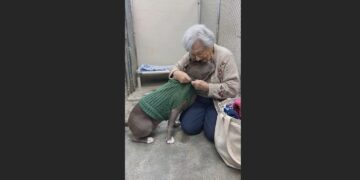








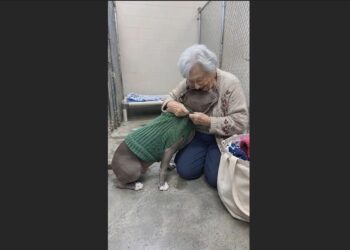
Arthur Pendelton walked into the shelter believing he knew what kind of dog he wanted.
Something young.
Cheerful.
A dog who might make his quiet house feel occupied again after the death of his wife.
Then he saw Barnaby.
The thirteen-year-old pit bull was nothing like the dog Arthur had imagined bringing home.
Barnaby had reportedly spent much of the previous two years withdrawing into the corner of his kennel. He did not rush toward visitors. He did not press against the gate or bring a toy forward. Even eye contact seemed difficult for him.
The shelter staff warned Arthur not to confuse compassion with readiness.
An elderly dog who had become deeply withdrawn might never become playful.
He might need extensive veterinary care.
He might prefer distance for a long time.
There was no guarantee that patience would produce the affectionate relationship Arthur secretly hoped for.
Arthur listened.
Then he filled out the adoption paperwork anyway.
He had entered the shelter looking for a dog to change the atmosphere of his house.
Instead, he chose one who seemed to understand silence.
Barnaby Had Already Lost the Life He Knew
The shelter staff knew enough about Barnaby’s history to understand why transition might be difficult.
He had once spent many years with the same person.
Then that life ended.
By the time Arthur met him, Barnaby was an old dog living in a kennel environment after more than a decade of familiarity elsewhere.
Dogs do not understand bereavement in the same abstract way humans do, but they absolutely notice when familiar people, smells, places, and daily patterns disappear.
For an older dog, such a disruption can be especially difficult.
Arthur understood that better than he expected.
His wife had died too.
Afterward, the house had remained physically unchanged in many ways.
The furniture was still there.
Her things were still there.
What had disappeared was the person who gave those objects meaning.
Arthur had spent two years discovering how large a familiar house could feel when one voice was missing.
Perhaps that was why Barnaby’s stillness did not scare him away.
The Shelter Tried to Make Sure Arthur Understood the Commitment
A staff member named Elizabeth spoke with him before the adoption was completed.
She was kind, but serious.
Barnaby was thirteen.
He was not a dog Arthur could reasonably expect to have for another decade.
His joints might already be stiff.
Senior veterinary costs could increase.
He might have accidents.
His tolerance for long walks or busy environments might be limited.
Behaviorally, the shelter could not promise that he would suddenly become outgoing once he left.
A dog who shuts down under stress can take weeks or months to begin making choices around new people.
Arthur did not tell Elizabeth he could heal Barnaby.
He could not.
He only said he had time.
That was something he could offer.
The Ride Home Was Quiet
Barnaby climbed into the back of Arthur’s vehicle without resistance.
But there was no excitement either.
He settled against the seat and looked toward the window.
Arthur talked to him during the drive.
Mostly because silence felt heavier than conversation.
He mentioned the house.
The garden.
The places where Barnaby could sleep.
At one point he quietly sang part of an old song his wife used to hum while they gardened.
Barnaby did not respond.
No lifted ears.
No tail movement.
No sudden connection.
He simply remained where he was.
Arthur let him.
A newly adopted dog does not owe the adopter reassurance.
Sometimes getting through the car ride is enough.
Barnaby Chose the Darkest Corner of the House
Arthur had prepared a thick bed in the living room.
It was soft, warm, and positioned where the dog could see much of the room without being in the middle of traffic.
Barnaby ignored it.
Instead, he found a darker corner and lowered himself onto the bare floor.
Arthur considered moving the bed.
Then decided against it.
The first night was not the time to insist that Barnaby use the space Arthur had chosen for him.
So Arthur sat in his chair several feet away.
Barnaby remained in the corner.
They did not interact much.
Arthur read.
Barnaby rested.
Occasionally, one looked toward the other.
Nothing dramatic happened.
That was the beginning.
Meals Required Distance
The first weeks taught Arthur how easily good intentions could become pressure.
If he placed food down and remained nearby, Barnaby often turned his head away.
If Arthur stood watching, the dog waited.
So Arthur changed the routine.
He put down the meal.
Spoke quietly.
Then left the room.
Only after the door closed would Barnaby approach the bowl.
Arthur could hear the faint movement of paws on the floor.
Then eating.
At first, Arthur worried that leaving reinforced Barnaby’s withdrawal.
But forcing proximity would have been worse.
A frightened dog needs enough safety to eat.
Arthur’s job was not to make Barnaby prove trust on a schedule.
It was to make meals predictable.
He Stopped Trying to Get Something From the Dog
That may have been the most important change Arthur made.
He stopped asking Barnaby to come closer.
Stopped expecting eye contact.
Stopped reaching toward him because affection seemed like the obvious answer.
Instead, each afternoon Arthur carried a chair into the same room and sat at a comfortable distance.
He drank tea.
Barnaby stayed in his corner.
Arthur talked.
Not because he believed Barnaby understood stories about marriage, loneliness, or aging.
The dog could not interpret those ideas as another person would.
But a steady human voice could become part of a predictable environment.
So Arthur talked anyway.
About his years as a craftsman.
About the garden.
About his wife.
About children who had grown up and built lives far away.
Barnaby listened in whatever way dogs listen.
Sometimes an ear shifted.
Sometimes his eyes closed.
Arthur learned not to ask for more.
Progress Came in Measurements Too Small to Celebrate Publicly
Barnaby began eating sooner after Arthur left the room.
Then he stopped waiting for the door to close completely.
Later, he drank while Arthur was still in the kitchen.
One afternoon, Barnaby moved from the far corner to a place several feet closer to Arthur’s chair.
The next day, he returned to the old spot.
Arthur did not treat that as regression.
Fearful dogs do not recover in a straight line.
A dog may explore one day and retreat the next.
Confidence is better measured by an expanding range of choices than by constant forward motion.
Over time, Barnaby’s world became a little larger.
That was enough.
One Rainy Morning, Barnaby Came Into the Kitchen
Arthur was making coffee.
Rain tapped against the windows.
He heard claws touch the floor behind him.
Not fast.
Not uncertain enough to stop.
He turned carefully.
Barnaby stood in the doorway.
For weeks, Arthur had been the one entering Barnaby’s space.
Now the dog had entered his.
Arthur stayed still.
Barnaby crossed the kitchen.
Then sat near his feet.
He did not ask to be touched.
Arthur did not immediately bend over him.
They simply stayed there.
The moment lasted only a few minutes.
Yet it changed the rhythm of the house.
The next morning, Barnaby came back.
Then again.
Soon Arthur began expecting the old dog beside him while breakfast was being made.
That Was Not a Cure
Barnaby still had difficult days.
He still sometimes chose distance.
Sudden sounds could make him tense.
Visitors needed to give him space.
He was not transformed into a young, exuberant dog.
Arthur did not need him to be.
A common mistake in rescue stories is to imagine one breakthrough as the point when fear disappears.
Real adjustment is usually quieter.
A dog approaches.
Then withdraws.
Tries something unfamiliar.
Needs rest.
Expands the safe zone.
Barnaby’s progress looked much more like that.
The kitchen had become another safe place.
Eventually, so did the porch.
Then the yard.
Arthur Began Thinking About the Outdoors Barnaby Had Once Known
From what Arthur had learned, Barnaby had previously lived around rural land.
That detail stayed with him.
Arthur had access to a small piece of agricultural property outside the area.
Quiet.
Open.
Grass.
Few people.
After Barnaby had been home for several months and had settled more reliably, Arthur considered taking him there.
He approached the idea cautiously.
Barnaby was thirteen.
A senior dog with stiff joints did not need to be encouraged into strenuous exercise merely because an open field looked beautiful.
Arthur also needed to know that transport itself would not overwhelm him.
So the first trip was simple.
Drive out.
Open the door.
Let Barnaby decide.
The Scent of the Field Caught His Attention
When the engine stopped, Barnaby lifted his head.
Outside were smells that did not exist in Arthur’s house.
Grass.
Damp soil.
Old vegetation.
Wind moving through the field.
Arthur clipped on the leash and helped Barnaby down.
For several minutes, the dog simply stood.
Then he began walking.
Slowly at first.
Nose working.
Arthur followed.
They stayed on manageable ground.
No rushing.
No expectation that Barnaby should perform some emotional return to his past.
He was simply an old dog outdoors.
Then Barnaby increased his pace.
For a Short Stretch, Barnaby Ran
It was not the smooth sprint of a young dog.
His body was thirteen years old.
The movement was heavier.
Less coordinated.
Arthur could see the stiffness that had accumulated over time.
Still, Barnaby broke into a run across a stretch of grass.
Arthur watched in surprise.
He did not interpret it as Barnaby running toward memories or trying to reclaim lost years.
There was no way to know what the dog associated with the landscape.
What Arthur could see was simpler.
Barnaby was engaged.
Moving by choice.
Interested enough in the environment to do something Arthur had never seen him do.
That alone brought tears to his eyes.
Arthur Did Not Let the Run Go Too Far
A senior dog can overdo physical activity quickly, especially when excitement temporarily masks fatigue.
Arthur followed and called Barnaby back before the outing became too demanding.
The old dog slowed.
Stopped.
Then turned toward him.
Arthur walked across the field.
He lowered himself carefully to Barnaby’s level.
This time, when Arthur reached out slowly, Barnaby remained.
Then the dog leaned into him.
Not dramatically.
Not as though every fear had disappeared.
He simply allowed the contact and rested his weight there for a moment.
Arthur stayed beside him in the grass.
Afterward, they walked back toward the vehicle at the pace Barnaby chose.
The Field Became Something They Repeated Carefully
Arthur returned on days when the weather was mild and Barnaby seemed physically comfortable.
Some trips included more walking.
Others hardly involved movement at all.
Barnaby sniffed.
Arthur sat.
They went home.
The outings were not treatment.
They were enrichment.
A way for an elderly dog to experience different scents and open space without pressure.
Barnaby never again ran as far as he did on that first trip.
Arthur was glad.
He cared more about keeping the dog comfortable than reproducing a memorable moment.
Age was not something either of them needed to defeat.
Barnaby Started Using the Dog Bed
That took longer than Arthur expected.
One evening, he entered the living room and found Barnaby asleep on the thick mattress he had ignored since his first night.
Arthur almost laughed.
The bed had never been the problem.
Timing was.
A frightened dog often chooses location before comfort.
Once Barnaby trusted the room enough, softness became useful.
After that, the bed became part of his routine.
During the day, he slept there.
At night, he gradually began choosing a spot closer to Arthur’s bedroom.
Eventually, Arthur placed another bed near the foot of his own.
Barnaby used that one too.
A Ball Appeared in the Yard One Afternoon
It was old.
Worn leather.
Something left from years earlier.
Barnaby found it while sniffing near a garden bed.
He picked it up.
Carried it a few steps.
Dropped it.
Arthur did not turn the discovery into a demanding game of fetch.
At thirteen, Barnaby did not need repeated high-impact chasing.
But the dog remained interested in the ball.
Sometimes he carried it.
Sometimes Arthur rolled it gently across the grass.
Barnaby might follow.
Might not.
The important change was not that Barnaby had become playful in some permanent sense.
It was that play had become one more option available to him.
Arthur’s House Changed Too
Not because Barnaby removed grief.
He did not.
Arthur still missed his wife.
There were mornings when an object in the kitchen or a song on the radio could bring the loss back with surprising force.
Barnaby could not repair that.
What he changed was the structure around it.
There was a dog waiting for breakfast.
Medication to remember.
A veterinary appointment on the calendar.
A slow evening walk.
A bed to wash.
A water bowl to refill.
Those responsibilities brought rhythm back into the house.
Grief remained.
It was no longer the only thing happening there.
Arthur Learned That companionship Is Not the Same as Healing
People sometimes told him that Barnaby had saved him.
Arthur did not use that phrase.
It made the relationship sound too simple.
Barnaby had not cured loneliness.
Arthur had not cured Barnaby’s fear.
They had become part of one another’s routines.
That was different.
Each had losses that existed before they met.
Those histories did not disappear.
Arthur could still remember his wife with love.
Barnaby could still react to unfamiliar situations based on experiences Arthur would never fully know.
A healthy new bond did not require erasing an old one.
Barnaby Grew More Comfortable With Touch
At first, Arthur waited for the dog to approach.
Over time, Barnaby began leaning into slow strokes along his shoulder.
He tolerated gentle grooming.
He sometimes rested his head against Arthur’s leg.
The change was gradual enough that Arthur barely noticed until one evening he realized his hand had been lying on Barnaby’s back for twenty minutes.
Months earlier, that would have been impossible.
Now the dog was asleep.
Trust had become less of an event and more of a routine.
That was exactly what Arthur had hoped for without knowing how to describe it.
Senior Care Became More Important as Barnaby Aged
By fifteen, Barnaby had slowed considerably.
His muzzle had turned mostly white.
Getting up after a long nap took more effort.
Arthur added rugs on slippery floors.
Walks became shorter.
They avoided hot afternoons.
Veterinary visits focused increasingly on comfort, mobility, appetite, sleep, and quality of life.
Arthur watched for pain instead of assuming stiffness was simply inevitable.
Some days Barnaby wanted a full circuit of the garden.
Other evenings, he went outside briefly and turned back toward the door.
Arthur followed his lead.
Old age did not make Barnaby less himself.
It merely changed what a good day looked like.
The Morning Routine Became Their Anchor
Barnaby no longer remained in a distant corner waiting for Arthur to leave.
Now he came toward the bedroom when morning arrived.
Sometimes he stood beside the bed.
Sometimes he rested his chin against the edge.
Arthur woke to the sound of breathing near him.
Then came the slow sequence of getting up.
Shoes.
Back door.
Breakfast.
Medication when needed.
Coffee for Arthur.
A quiet kitchen.
Nothing remarkable.
That was why it mattered.
The dog who once would not eat while Arthur remained in the room now rested nearby while Arthur prepared his own breakfast.
No miracle had occurred.
Years of predictable mornings had.
Arthur Never Forgot the Warning Elizabeth Gave Him
Barnaby might never play.
Might never run toward him.
Might never offer the kind of obvious affection people expect from an adopted dog.
Elizabeth had not been trying to discourage Arthur.
She had been protecting both of them from unrealistic expectations.
That warning helped.
Because Arthur had entered the adoption willing to accept less.
If Barnaby had remained reserved, he would still have had a home.
If affection came slowly, Arthur could wait.
If the relationship never looked like the one he imagined, it could still be worthwhile.
Paradoxically, expecting less gave Barnaby room to offer more.
Barnaby Was Never “Broken”
Arthur stopped thinking in those terms.
The dog had been frightened.
Withdrawn.
Possibly overwhelmed by prolonged change and stress.
But “broken” implied that his value depended on becoming repaired.
Barnaby had always been a complete animal.
Even in the kennel corner.
Even when he could not bring himself to approach food with Arthur nearby.
The adoption did not manufacture worth.
It gave him a quieter environment and enough time to show behavior that had been difficult to express in the shelter.
That distinction changed the way Arthur talked about him.
Their Evening Walk Became Smaller With Age
At fifteen, the field trips were rare.
Long walks were unnecessary.
Most evenings, Arthur and Barnaby simply circled the garden.
Slowly.
Arthur carried a flashlight after dark.
Barnaby stopped frequently to smell the same places he had smelled the previous evening.
Arthur no longer hurried him.
Neither had anywhere urgent to be.
When Barnaby became tired, they returned inside.
Arthur settled into his chair.
Barnaby lowered himself onto the bed.
Sometimes both fell asleep before the television program ended.
The house was still quiet.
It simply was not empty.
Arthur Had Gone Looking for Youth
That was the irony he came back to most often.
He had imagined adopting a younger dog because he thought energy was what his life lacked.
A dog who would run.
Play.
Force him out of the house.
Instead, he chose a thirteen-year-old pit bull who initially wanted almost nothing except distance.
The relationship that followed was slower than Arthur had expected.
Maybe that was exactly why it suited him.
Neither needed to be hurried.
Neither needed to pretend that loss had not changed them.
They could simply build routines around what remained.
Barnaby Never Replaced Arthur’s Wife
Arthur was careful about that too.
Dolores had been part of his adult life for decades.
No dog could occupy that role.
Nor should one.
Barnaby did something else.
He became a companion in the life Arthur had after her death.
That distinction allowed Arthur to remember without feeling that moving forward meant leaving something behind.
The same principle applied to Barnaby.
Whatever attachment he had formed during his first eleven years did not need to disappear for a new bond with Arthur to become real.
New relationships do not always replace old ones.
Sometimes they are simply added beside them.
At Fifteen, Barnaby Still Has Difficult Days
Age brings them.
A stiff morning.
A reduced appetite.
A day when sleep seems more interesting than the yard.
Arthur pays attention.
He works with the veterinarian.
He keeps Barnaby comfortable.
He also understands that love will not stop an elderly dog’s body from aging.
The promise Arthur made was never that Barnaby would live forever.
It was that the time he had would be cared for.
That is a promise Arthur can keep.
The Corner Where Barnaby First Slept Is Empty Now
The thick bed has moved closer to Arthur’s bedroom.
The old leather ball still appears occasionally in the yard.
The wooden chair Arthur once positioned at a cautious distance from Barnaby is back where it belongs.
Arthur no longer needs to sit across the room and talk simply to make his presence predictable.
Barnaby already knows his footsteps.
He knows the morning routine.
He knows where the water bowl sits.
He knows the garden.
And he knows where Arthur sleeps.
Their Story Was Never About Two Damaged Hearts Fixing Each Other
Arthur once might have described it that way.
He no longer would.
Grief is not a broken machine.
Fear is not a defect.
Barnaby did not mend Arthur’s life.
Arthur did not erase Barnaby’s past.
What happened was quieter and, in some ways, more useful.
One elderly man had time.
One elderly dog needed it.
Arthur provided predictable food, medical care, space, and companionship.
Barnaby provided presence.
From there, familiarity accumulated.
So did trust.
Eventually, a relationship formed.
Every Morning, Barnaby Still Comes Looking for Arthur
His steps are slower now.
Sometimes his nails slide slightly on the rugs.
The white across his muzzle has widened.
He reaches the side of Arthur’s bed and stands there until Arthur wakes.
Arthur opens his eyes.
Barnaby waits.
Then they begin another ordinary day.
There was a time when Arthur believed he needed a young dog to bring life back into the house.
Instead, a thirteen-year-old pit bull taught him that companionship does not have to arrive loudly.
Sometimes it begins with a dog staying in the far corner.
A man sitting several feet away.
Food placed down without demands.
A chair returned to the same place every afternoon.
Then, one rainy morning, the sound of old claws crossing a kitchen floor.
Barnaby is fifteen now.
He no longer runs across fields.
Arthur no longer expects him to.
They take a slow turn around the garden in the evening and return inside together.
The house is still quiet.
Arthur still carries the memory of the woman he loved.
Barnaby still carries a history Arthur cannot fully know.
But when the old dog settles near the bed each night, both of them have something they did not have before.
Not a replacement for what was lost.
A life beside someone who stayed.







Discussion about this post