












For eight months, Buddy stopped coming to the front of his kennel.
At first, the old Dalmatian still stood when visitors entered the shelter hallway.
He would lift his gray muzzle.
Watch.
Wait.
Then another family would continue toward younger dogs.
Another child would point somewhere else.
Another couple would pause for a moment, read his age, and move on.
Eventually, Buddy stopped getting up.
He remained near the back of the kennel and watched people pass.
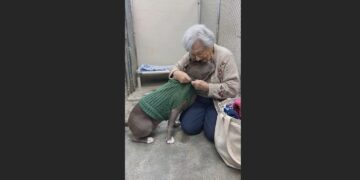
Then, on a rainy afternoon, an elderly woman in a pale blue cardigan entered the hallway.
She took several slow steps.
Stopped in front of Buddy’s kennel.
And pressed both hands to her chest.
Eleven years earlier, Eleanor had carried that spotted dog home as a puppy.
Months earlier, circumstances had forced them apart.
Now only a metal gate separated them.
“Buddy,” she said softly. “It’s me.”
For several seconds, the old dog did not move.
Then one ear lifted.
His tail moved once against the floor.
Buddy Had Once Followed Eleanor Everywhere
For most of his life, there had been nothing unusual about their routine.
Eleanor moved through the apartment.
Buddy followed.
Kitchen.
Bedroom.
Living room.
Doorway.
Back again.
After Eleanor’s husband died, the pattern became even more constant.
Buddy slept beside her bed.
He waited nearby while she made breakfast.
He accompanied her through the quiet parts of the day when the absence of another person could make a familiar home feel different.
That companionship did not erase Eleanor’s grief.
A dog cannot replace a spouse.
But Buddy gave her days a structure they otherwise might not have had.
Food.
Walks.
Veterinary appointments.
A warm body breathing nearby at night.
For years, that was their life.
Then Eleanor fell.
One Accident Changed Everything
The fall was serious.
Eleanor could no longer move safely on her own.
Doctors recommended rehabilitation.
She needed help regaining strength and balance before returning to independent living.
The rehabilitation center available to her did not allow pets.
At first, Eleanor believed the separation would be brief.
A relative might take Buddy.
A friend might help.
Someone would surely manage an elderly Dalmatian for a few weeks.
But plans fell apart.
No relative could provide long-term care.
Buddy was older.
He had routines.
He needed exercise, veterinary attention, and a household able to accommodate him.
Eventually, Eleanor faced the option she had been trying to avoid.
Buddy would have to go to the shelter.
The Shelter Intake Was Hard on Both of Them
Eleanor brought what records she had.
Veterinary history.
Food information.
Notes about Buddy’s habits.
She explained that he preferred sleeping close to the bed.
That sudden slippery flooring made him cautious.
That he was slower now than he had once been.
The shelter staff listened.
They understood that this was not an abandonment born of indifference.
Eleanor simply did not have a safe place for Buddy while she recovered.
Before leaving, she lowered herself as far as her condition allowed.
Buddy stood close.
Eleanor pressed her forehead gently to his.
“Wait for me,” she whispered.
Buddy could not understand a human promise about rehabilitation, housing, or return.
What he could understand was that his person walked away.
And did not come back the next day.
Recovery Took Much Longer Than Eleanor Expected
Weeks turned into months.
Progress came slowly.
At first, walking safely across a room required concentration.
Then came longer distances.
Stairs.
Balance exercises.
The work was tiring.
Eleanor kept asking when she might be able to leave.
But physical recovery was only part of the problem.
By the time she was ready for more independent living, her old apartment was no longer available.
That created another obstacle.
She needed a place she could afford.
A place suited to her mobility.
And, if she hoped to bring Buddy back, a place that allowed dogs.
Eleanor refused to stop asking about that last requirement.
Buddy Was Becoming an Old Dog in a Shelter
Meanwhile, shelter life continued without her.
At first, Buddy responded to every set of footsteps.
He came forward when people approached.
He watched the hallway.
He seemed interested whenever someone stopped.
But an eleven-year-old Dalmatian is not the dog most families enter a shelter expecting to adopt.
His muzzle had turned gray.
His legs were stiff.
He did not bounce at the gate.
He did not compete with younger dogs for attention.
And slowly, the behavior changed.
Buddy began remaining farther back.
He still observed.
He simply stopped coming forward every time a stranger passed.
Shelter staff did not describe him as hopeless.
They described him as quieter.
Senior Dogs Ask Different Questions of Adopters
A young dog often represents years of possibility.
A senior dog represents responsibility that may arrive sooner.
Arthritis.
Medication.
Dental care.
Possible hearing or vision changes.
Shorter walks.
More frequent veterinary visits.
Potential mobility support.
Those realities should not be hidden.
They also do not make an older dog less adoptable.
Some senior dogs are already comfortable with household routines.
Many need less intense exercise.
They may settle easily into quiet homes.
Buddy needed the right person.
The shelter simply had no way to know that the person he had lived with for eleven years was still trying to get back to him.
Eleanor Kept Looking for Housing
The process was frustrating.
Some places did not allow dogs.
Others allowed small pets but excluded larger ones.
Some did not fit her mobility needs.
She needed something manageable.
Ground-level access mattered.
So did proximity to services.
Eventually, a senior community offered her a small home.
Dogs were allowed.
The moment Eleanor received the keys, she did not unpack.
She did not arrange furniture.
She did not call friends.
She called the shelter.
“Is Buddy still there?”
Yes.
He was.
She Came Back in a Pale Blue Cardigan
Rain tapped against the windows that afternoon.
A staff member met Eleanor near the entrance.
She walked slowly through the kennel hallway.
Her body had changed since Buddy last saw her.
Her movement was more cautious.
Her pace was slower.
But her voice remained the same.
When she reached the kennel, she stopped.
Buddy lay at the back.
For a moment, Eleanor simply looked at him.
Eight months of waiting.
Eleven years of life before that.
The shelter worker stood beside her and gave both of them time.
Then Eleanor said his name.
“Buddy.”
One ear rose.
Recognition Was Not Instant Theater
Buddy did not leap from the back of the kennel.
He was old.
Stiff.
And facing a person he had not seen for months.
He stared.
The worker reached for the latch but did not open it immediately.
Eleanor spoke again.
“It’s me.”
Buddy’s tail moved once.
Then again.
The gate opened.
Eleanor lowered herself carefully toward the floor.
She did not call loudly.
Did not slap her knees.
Did not reach through the doorway.
She waited.
Buddy stood.
Slowly.
The First Few Steps Were Uncertain
His legs were stiff from age and from lying down.
He crossed part of the kennel.
Paused.
Then entered the hallway.
Halfway between the gate and Eleanor, he stopped.
His nose lifted.
Dogs recognize familiar people through multiple cues.
Voice.
Movement.
Appearance.
And especially scent.
Whatever combination reached Buddy in that moment, his hesitation changed.
He moved forward.
Not running.
Not jumping.
Walking directly toward Eleanor.
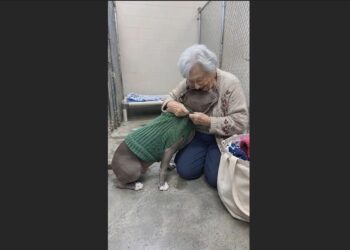
Then he pressed his head beneath her chin.
Eleanor Wrapped Her Arms Around Him Carefully
Buddy leaned.
All of him.
The weight nearly pushed Eleanor backward, so the staff member stayed close in case she needed support.
Eleanor laughed and cried at the same time.
Her hands moved through the familiar spotted coat.
Gray now in places that had once been dark.
Buddy remained against her.
“I told you I would come back,” she whispered.
Buddy did not understand the sentence as a fulfilled promise.
He did not need to.
He had his familiar person in front of him again.
That was enough.
The Shelter Still Had Paperwork to Complete
Emotion did not eliminate procedure.
Eleanor was returning to independent housing after a serious injury.
The shelter needed to make sure the new arrangement was safe for both of them.
Could she manage Buddy physically?
What happened if he slipped or became unable to stand?
Was there family support nearby?
Could someone help with veterinary transport?
Did the senior community truly permit a dog of his size?
All of that had to be confirmed.
It was.
Eleanor had already thought through most of it.
She had spent months planning for exactly this possibility.
Buddy Was Older Than the Dog She Had Surrendered
Eight months mattered at his age.
He had slowed.
His joints were stiffer.
The shelter discussed senior veterinary care.
Rugs could help on slippery floors.
Walks should match his comfort rather than an old routine from years earlier.
Weight management would matter.
So would watching for pain, appetite changes, mobility problems, and other signs that aging required medical attention.
Eleanor listened closely.
She had not fought for dog-friendly housing because she expected Buddy to become young again.
She wanted the dog he was now.
That distinction mattered.
That Afternoon, Buddy Left the Shelter
The hallway he had watched for eight months disappeared behind him.
He did not glance back in some deliberate gesture of farewell.
Dogs do not need to narrate departures.
He walked beside Eleanor as staff helped them toward the exit.
The new home was smaller than the place they had shared before.
Eleanor’s furniture was limited.
Boxes remained unopened.
Buddy did not care.
He explored.
Sniffed the walls.
Found his water.
Checked the hallway.
Then followed Eleanor toward the bedroom.
That Night, He Chose the Same Place
Not the exact same floor.
Not the same apartment.
But the same position.
Beside Eleanor’s bed.
For eleven years, that had been his nighttime place.
Now he circled carefully and lowered himself there again.
Eleanor sat on the edge of the mattress.
She looked down.
Buddy sighed.
The room was unfamiliar.
The routine was not.
That helped both of them.
Neither Had Spent Those Eight Months Simply Waiting
Eleanor had been working.
Rehabilitation.
Housing applications.
Mobility.
Planning.
Buddy had been adapting too.
He learned shelter sounds.
New feeding routines.
Different caregivers.
The absence of the person he had known for most of his life.
It is tempting to turn those months into a story about two lives frozen until reunion.
They were not.
Both continued.
The reunion mattered precisely because life had continued without guaranteeing it.
Eleanor’s Return Did Not Erase Buddy’s Shelter Experience
He still needed time to settle.
Some dogs return to familiar people and routines quickly.
Others show temporary uncertainty after major transitions.
Buddy slept more during the first days.
He moved slowly around the new home.
Eleanor kept things predictable.
Food stayed in the same place.
Furniture did not move unnecessarily.
Walks were short.
She allowed him to rest.
The goal was not to recreate exactly the life they had before.
Neither of them was the same.
They had to build a workable version of life now.
Eleanor Had Changed Too
She used a cane some days.
She moved cautiously.
There were things she could no longer do alone.
That required humility.
So did caring for an aging dog.
A neighbor helped with heavier tasks.
Family assisted when appointments required transportation.
The senior community had staff nearby if Eleanor needed help.
Buddy’s world became smaller than it had been when he was young.
So had Eleanor’s.
That did not make either life empty.
Their Walks Became Slow
A few minutes outside.
A pause.
Another few steps.
Buddy smelled everything.
Eleanor let him.
Neither needed distance.
The walks were less about exercise than movement, air, routine, and maintaining whatever mobility remained comfortable.
Sometimes another resident stopped to say hello.
Buddy did not always respond much.
He had become an old dog with an old dog’s priorities.
Eleanor understood.
They had both earned the right not to hurry.
The Shelter Staff Remembered the Reunion
Not because Buddy had performed some impossible act of recognition.
What moved them was simpler.
They had watched an elderly dog become quieter over months.
Then a woman came through the door and provided context they had been missing.
Buddy had belonged somewhere before the shelter.
He had slept beside someone’s bed.
He had spent eleven years inside another person’s daily life.
The gray muzzle at the back of the kennel was not the beginning of his story.
It was one chapter in the middle.
Eleanor Never Called the Shelter Months Too Late Again
She stayed in contact.
Updates came occasionally.
Buddy eating breakfast.
Buddy asleep near her chair.
Buddy walking slowly outside the community.
Nothing remarkable.
Those were the best updates.
They meant the reunion had stopped being an event.
It had become ordinary life again.
That is often the real goal of rescue and reunion.
Not a permanent emotional climax.
Routine.
Buddy Did Not Need to Remember a Promise
People loved that part of the story.
“Wait for me.”
Then Eleanor returning eight months later.
It sounded as though Buddy had spent every day consciously holding her words.
There was no reason to claim that.
Dogs do not understand long-term promises in the way people do.
What Buddy could remember was Eleanor.
Her scent.
Voice.
Movement.
Years of familiarity.
The recognition did not require language.
It had eleven years behind it.
Eleanor Did Not Come Back Because Love Made Everything Easy
She came back because she kept solving practical problems.
She recovered enough to live more independently.
She searched for housing.
She found a place that allowed Buddy.
She built support around the limitations both of them now had.
Love motivated the effort.
Planning made the reunion possible.
That is an important distinction.
Many people care deeply for animals they cannot safely keep.
Sometimes circumstances remain impossible.
Eleanor was fortunate enough to find a workable path back.
Eight Months Earlier, She Had Left Alone
That memory never disappeared completely.
The shelter door.
Buddy staying behind.
The knowledge that she could not explain why.
Now she had a different doorway.
A small home in a senior community.
Buddy inside.
At night, she could hear him settle beside the bed again.
Not the young Dalmatian she had carried home eleven years earlier.
An old dog.
Gray muzzle.
Stiff legs.
Still familiar.
The Best Part Was How Ordinary It Became
Morning.
Eleanor got up carefully.
Buddy took longer.
They ate.
Went outside.
Returned.
He slept.
She read.
Some evenings, Buddy rested near her feet.
At night, he returned to his place beside the bed.
There was no need for either of them to spend every day reenacting the reunion.
The important thing had already happened.
A woman who had been forced to surrender her dog recovered enough to build a life where he could return.
An old Dalmatian who had spent eight months watching families pass his kennel was back beside the person he had known for eleven years.
Not because he had understood a promise.
Because when Eleanor finally had the keys to a home that could hold them both, the first call she made was to the shelter.
And that evening, Buddy slept beside her bed again.
Editor’s Note: The characters in this story are fictional. Through these stories, we hope to share the intelligence, loyalty, compassion, and loving nature of dogs with people everywhere.







Discussion about this post