












For the first several weeks after Rex came home, almost everything frightened him.
A door closing too quickly.
A hand raised above waist level.
A pan shifting in the kitchen.
Footsteps approaching from the wrong direction.
Rex was a scarred pit bull whose history, according to the rescue that placed him with me, included years connected to illegal dogfighting.
By the time he reached my house, his body carried reminders of that past.
His behavior carried others.
He spent most of each day in the same corner of the living room.
I gave him food, space, veterinary care, and a quiet routine.
I avoided reaching over him.
I stopped asking for affection.
Still, Rex seemed unable to relax when I was near.
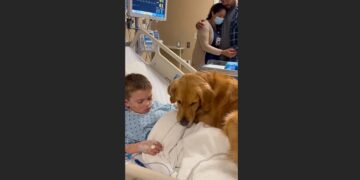
Then my neighbor’s golden retriever entered the house.
Not as a miracle.
Not as a cure.
Just as another dog willing to lie down several feet away and ask for nothing.
That simple presence became the first thing Rex voluntarily moved toward.
Rex Had Learned That Distance Felt Safer
The rescue had warned me not to expect quick progress.
Rex was not aggressive with me.
That distinction mattered.
When frightened, he did not charge or snap.
He froze.
His muscles tightened.
His head lowered.
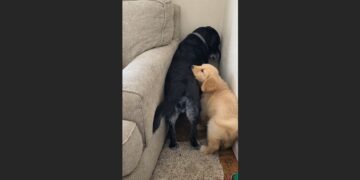
Sometimes he pressed himself so close to the wall that it seemed as though he wanted to disappear into it.
I had been told that his previous life had involved years of exploitation and violence.
I could not know what every scar meant or which experiences had shaped which behavior.
What I could see was a dog who watched every movement around him.
So I began changing mine.
I walked more slowly.
Turned sideways instead of approaching directly.
Placed food down and backed away.
If Rex needed the corner, the corner remained available.
Love Was Not Enough by Itself
That was difficult for me to accept at first.
I had believed that once Rex entered a safe house, he would somehow recognize the difference.
Warm bed.
Regular meals.
No shouting.
No punishment.
Surely he would understand.
Dogs do not recover from fear because humans believe the environment is safe.
They learn through repeated experience.
One uneventful day.
Then another.
And another.
Rex needed consistent care, low-pressure handling, veterinary support, and time.
My affection could support those things.
It could not replace them.
That lesson changed how I treated him.
Instead of trying to make Rex feel loved, I concentrated on becoming predictable.
The Golden Retriever Had Visited Once Before
My neighbor owned an easygoing golden retriever.
The first introduction had been brief and supervised.
Rex remained in his corner.
The retriever showed some initial excitement, then left.
At the time, I assumed nothing meaningful had happened.
Rex had not approached.
He had not wagged.
He had barely moved.
Then, after speaking with my neighbor the following day, I found myself thinking about the encounter differently.
Perhaps another controlled visit was worth trying.
Not because I believed the golden retriever possessed some mysterious ability to heal Rex.
But some fearful dogs do take useful information from calm, socially appropriate dogs.
If both animals remained comfortable, another quiet exposure might tell us something.
My neighbor agreed to come back.
The Second Visit Looked Completely Different
This time, the golden entered slowly.
There was no bouncing around the room.
No attempt to rush toward Rex.
We kept the dogs separated by enough space that neither was forced into contact.
The retriever walked partway across the living room.
Then stopped roughly six feet from Rex.
He lay down.
Head on his paws.
He did not stare.
He did not crawl closer.
He simply rested.
Rex had tightened when the door opened.
But he did not retreat farther.
After several minutes, his head lifted slightly.
He looked toward the other dog.
Then kept looking.
For the first time since Rex had entered my home, curiosity seemed to compete with fear.
I Did Almost Nothing
That was deliberate.
I sat in my chair.
The retriever stayed where he had chosen to settle.
Rex remained in his corner.
Nobody called him.
Nobody shook treats.
Nobody tried to manufacture a friendship.
The afternoon became almost boring.
That was exactly what I wanted.
The golden shifted occasionally.
Rex watched.
The house stayed quiet.
A relationship between two dogs cannot be forced simply because humans think companionship would be beneficial.
Either dog needed to be free to disengage.
So we supervised.
We watched body language.
And we left space between them.
Hours passed.
Rex did not approach.
Still, he remained present instead of shutting down completely.
That alone felt significant.
Dinner Gave Us Another Small Change
I prepared food for both dogs.
They were fed separately enough to prevent competition.
The golden ate calmly.
Rex stayed back at first.
Then he emerged.
Slowly.
He looked toward the other dog.
The retriever remained relaxed and uninterested in Rex’s bowl.
Rex stopped.
Then continued.
He ate.
While I was still in the room.
Until that evening, Rex usually waited for me to leave before approaching his food.
I tried not to react.
No praise.
No excited voice.
I did not want eating in my presence to become another performance.
I simply sat there and let him finish.
For me, the change was enormous.
For Rex, perhaps it was one more safe experience.
The Golden Came Back the Next Day
Again, we kept the meeting controlled.
Again, the retriever did not rush Rex.
This time, he settled closer.
Not pressed against him.
Just nearer than before.
Rex watched.
His breathing gradually slowed.
The tight line through his back softened.
For most of the morning, they existed in the same room without requiring anything from one another.
Then, during the evening, Rex stood.
He took a step toward the golden.
Stopped.
Another step.
The retriever remained lying down.
Rex lowered himself beside him.
At first, a small gap remained.
Then Rex shifted closer until his muzzle rested against the other dog’s coat.
Both dogs slept.
I sat across the room and cried.
Quietly.
I Had to Be Careful About What That Moment Meant
It would have been easy to say Rex finally knew he was safe.
Or that the golden understood exactly what Rex had survived.
I could not know either thing.
Dogs do not need a human narrative about trauma in order to influence one another.
They communicate through posture, movement, scent, distance, and repetition.
The golden was calm.
He did not pressure Rex.
Rex chose proximity.
That was enough.
The moment mattered precisely because Rex had made the choice himself.
It was not evidence that every frightened dog needs another dog.
Some fearful dogs are uncomfortable around unfamiliar animals and require a completely different approach.
Rex happened to respond well to this individual dog.
Progress Began Showing Up Elsewhere
Over the following days, Rex started leaving the corner more often.
Not constantly.
Not confidently every time.
But his world grew.
He explored the hallway.
Sniffed the kitchen entrance.
Walked toward the back door when the golden did.
Eventually, Rex began approaching me without the other dog directly beside him.
He sniffed my hand.
Then walked away.
A few days later, he did it again.
The distance he required became smaller.
His recovery was still uneven.
A loud noise could send him back toward the wall.
A visitor could make him tense.
But fear no longer appeared to control every decision.
Rex had more options.
The Golden Did Not Become His Full-Time Guide
That was important.
I did not want Rex to learn that he could function only when the other dog was present.
The retriever visited frequently, but Rex also needed opportunities to explore independently.
So we built confidence in both contexts.
Short walks.
Quiet time in the yard.
Food enrichment.
Low-pressure interaction with me.
Rest.
Some days the retriever came over.
Some days he did not.
Rex learned that safe things could happen either way.
The friendship remained valuable.
Dependence was not the goal.
One Afternoon, Rex Ran in the Yard
I came home earlier than usual.
The golden was visiting.
Both dogs were outside under supervision.
When I stepped through the gate, I stopped.
Rex was moving faster than I had ever seen him move.
He followed the golden across the grass.
Then turned.
The retriever chased for several yards.
Rex circled back.
There was something almost puppy-like in the movement.
Yet I reminded myself that activity was not proof his history had vanished.
Nor did running mean he was completely comfortable in every situation.
It meant that in that yard, at that moment, Rex felt secure enough to play.
That was more than enough for me.
He Did Not Need Strictness to Become a Different Dog
Rex needed structure.
But structure is not the same thing as harshness.
He benefited from consistency.
Clear routines.
Appropriate boundaries.
Predictable handling.
What he did not need was intimidation.
His fearful behavior was not a challenge to my authority.
It was information.
When his body tightened, I listened.
When he moved away, I gave him room.
When he approached, I allowed the approach without demanding more.
The golden seemed to do something similar naturally.
He existed nearby without insisting Rex interact.
That made him a useful social companion.
Not a therapist.
Not a miracle worker.
A calm dog.
My Neighbor Saw Their Relationship Changing Too
She loved her golden deeply.
So when it became clear how comfortable the dogs were together, we talked about what made sense.
The original story of their bond makes it tempting to imagine that she immediately handed over her dog forever because their friendship seemed special.
Real life needed more consideration than that.
A dog’s home should not change simply because an emotional moment feels meaningful.
We talked about routines.
Veterinary care.
Expenses.
My housing.
Her circumstances.
Whether the retriever was genuinely comfortable spending so much time in my home.
And whether keeping the two dogs together permanently was actually good for both animals.
Only after practical planning did the arrangement become permanent.
Two Dogs Changed the Household
There was more work.
More food.
More hair.
More veterinary planning.
Separate attention for each dog.
Individual walks sometimes.
Different training needs.
I did not allow the golden’s role in Rex’s progress to erase his own identity.
He deserved games, affection, rest, and relationships that had nothing to do with supporting Rex.
Likewise, Rex needed to become more than “the traumatized dog.”
Their friendship mattered.
Their individuality mattered too.
A healthy bond leaves room for both.
Rex Still Startled Sometimes
Months later, sudden noises could still affect him.
A dropped pan.
Thunder.
Something falling against the fence.
He might freeze or retreat.
That was not proof that all our progress had disappeared.
Fear can remain part of an animal’s behavioral history even after life becomes much safer.
What changed was recovery.
Rex could settle sooner.
He sought familiar places.
Sometimes he approached me afterward.
Sometimes he lay beside the golden.
Other times he simply chose a quiet room alone.
All three responses were acceptable.
His Scars Never Disappeared
They remained visible beneath the coat.
Some were easier to see in bright light.
Others had faded.
People occasionally asked about them.
I stopped giving long explanations.
Rex did not need to spend the rest of his life as evidence of what humans had done to him.
He had veterinary appointments.
Favorite places in the yard.
Food preferences.
A dog he enjoyed sleeping beside.
A person whose footsteps he recognized.
That life deserved attention too.
Survival was part of his story.
It did not need to remain the only part.
The Friendship Helped Me Understand Trust Differently
I had originally imagined trust as a point we would eventually reach.
Before trust: Rex hides.
After trust: Rex loves me.
That was far too simple.
Trust changed depending on context.
Rex might approach me calmly in the living room and become uncertain when I carried a large object.
He might sleep beside the golden but want distance during feeding.
He could trust one person and remain wary of another.
Progress meant building many separate safe experiences.
The golden did not create trust for Rex.
He participated in some of those experiences.
Rex did the learning.
I Also Had to Stop Thinking I Could Repair Him
Rex was never a broken object.
He was a frightened dog whose behavior had adapted to difficult circumstances.
That language changed everything for me.
Broken things need fixing.
Living animals need care.
Assessment.
Safety.
Time.
Choice.
Sometimes professional help.
Once I stopped trying to restore Rex to some imaginary version of the dog he might have been, I became better at seeing the dog standing in front of me.
He did not need to become fearless.
He needed a life in which fear was no longer constant.
Their Evenings Became Ordinary
Eventually, I stopped watching every interaction.
That was one of the clearest signs that life had settled.
The golden might stretch across the rug.
Rex might sleep a few feet away.
Sometimes their backs touched.
Sometimes they chose opposite sides of the room.
I could read without monitoring whether Rex was breathing too quickly.
Dinner became routine.
The yard became familiar.
The corner where Rex had once spent most of the day remained available.
He rarely used it.
Not because I blocked it.
Because he had found other places.
Rex Began Waiting Near the Door
When I returned from work, the golden usually arrived first.
Tail moving.
Body loose.
Rex stayed farther back.
Then one evening, I opened the door and found both dogs there.
Rex’s tail moved once.
Then again.
A restrained greeting.
Very different from the golden’s enthusiasm.
Perfectly Rex.
I put my bag down.
Did not rush toward him.
Rex walked forward and leaned briefly against my leg.
Then went to the kitchen.
That was the kind of moment I had once thought needed tears and dramatic meaning.
By then, it simply made me smile.
The Golden Never Erased Rex’s Past
Nor should he have.
The years before Rex entered my home remained part of his history.
His body had aged through them.
His behavior had been shaped by them.
A new relationship could not make those years unhappen.
What companionship could do was contribute to different experiences afterward.
A calm room.
A shared yard.
A sleeping dog nearby.
A human who stopped reaching when Rex said no.
Enough repetition for his expectations to begin changing.
That was slower than a miracle.
It was also more believable.
I Thought I Was Bringing One Dog Home
Instead, over time, the household became three lives learning how to share space.
Rex.
The golden.
Me.
There were no mystical conversations between the dogs.
No promise that either would always know exactly what the other needed.
They had occasional disagreements like normal dogs.
They wanted the same sleeping spot sometimes.
One stole toys from the other.
Meals remained managed carefully.
And yet they chose one another often.
That choice mattered.
Rex Eventually Became Comfortable Enough to Rest Deeply
The first time I noticed, both dogs were asleep in the living room.
The golden was on his side.
Rex lay several feet away.
No touching.
No protective arrangement.
Just sleep.
Rex’s body was loose.
His legs stretched outward rather than tucked beneath him.
A noise came from outside.
One ear moved.
His eyes stayed closed.
That image affected me more than the dramatic moments had.
Rest is vulnerable.
Rex had once treated nearly every sound as information requiring a response.
Now sometimes a sound was only a sound.
The Best Thing the Golden Gave Rex Was Not Protection
It was another example of ordinary life.
Someone could walk through the room and nothing happened.
A bowl could appear and be eaten from safely.
A person could sit nearby without reaching.
A dog could sleep without watching every doorway.
Rex observed those patterns.
Then increasingly participated in them.
Perhaps he would have reached many of those same milestones without the golden.
We will never know.
Recovery rarely has one cause.
What I do know is that calm canine companionship became one useful part of a larger support system.
Today, Fear No Longer Occupies the Whole House
Rex still has scars.
He still has moments when old caution returns.
But he also has routines.
He walks through the garden without staying glued to another dog’s side.
He approaches me because he chooses to.
He plays sometimes.
Sleeps deeply.
And when the golden settles nearby, Rex often lowers himself too.
Their friendship did not repair six years of suffering.
Nothing could.
It gave Rex something else.
Safe experiences in the present.
I used to think my job was to show him that the world could be good.
That was too large a promise.
Now I concentrate on making this house predictable.
This meal safe.
This walk manageable.
This afternoon quiet.
The golden helped with that by being exactly what he was.
A calm dog who never asked Rex to explain himself.
And over time, Rex stopped spending every day against the wall.
Not because another dog rescued him.
Because enough safe days accumulated that he began choosing the rest of the house for himself.







Discussion about this post