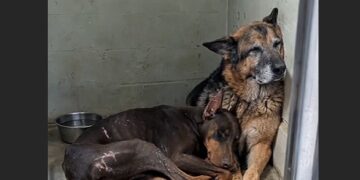








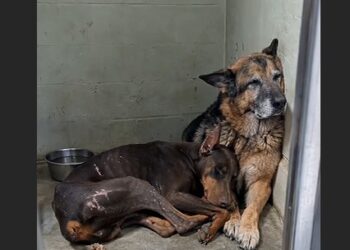
The first time I saw Rex sleeping peacefully, his head was resting against the shoulder of a dog who couldn’t see him.
He was only one year old, a young Doberman who should have been curious about everything around him. Instead, he spent his days curled in the corner of his kennel, trembling at unfamiliar sounds and avoiding anyone who approached.
Beside him lay Bella, a 12-year-old German Shepherd who had been blind for years. She was the dog visitors walked past without stopping, the one whose age and disability seemed to make her invisible to people searching for a companion.
I had worried about both of them for a long time.
But I never expected that bringing them together would change their lives so profoundly.
My name is Thomas, and I’ve worked with shelter dogs long enough to understand that trust cannot be rushed. Still, there are moments in this work that challenge everything you think you know.
For me, one of those moments happened in the middle of the night, when I returned to the shelter because I couldn’t stop worrying about two dogs sharing a kennel.
What I found was something I will remember for the rest of my life.
Two Dogs Who Had Almost Stopped Trying
Rex was one of the youngest dogs in our care, but there was very little about his behavior that reminded me of a typical one-year-old Doberman.
Most dogs his age are eager to investigate their surroundings. They want to run, play, sniff unfamiliar things, and discover how the world works.
Rex wanted none of that.
He spent much of his time pressed against the back wall of his enclosure, his body tense and his eyes following every movement around him.
He showed little interest in food or play. When someone approached, he often withdrew farther into his corner.
We didn’t know everything that had happened before he arrived, and I was careful not to assume that every frightened reaction had a simple explanation.
But one thing was clear.
Rex was a young dog who seemed unable to feel comfortable anywhere.
I found myself worrying about him even after I left work.
Then there was Bella.
The Old German Shepherd Everyone Walked Past
Bella was 12 years old, with a graying muzzle, slower movements, and eyes that could no longer see the world around her.
She had learned to navigate familiar surroundings through sound, scent, and careful movement.
She wasn’t the sort of dog who rushed toward visitors when they entered the shelter.
Instead, she usually remained quiet, listening to the activity around her.
People came looking for energetic puppies, playful young dogs, or companions they could take on long adventures.
A blind senior German Shepherd rarely seemed to fit those plans.
I watched families stop at neighboring kennels while Bella remained where she was.
Sometimes someone asked about her age or condition.
Usually, they moved on.
I understood that adopting a senior dog with special needs was a serious commitment. Bella would need a home where people respected her limitations and helped her navigate safely.
But I wished more visitors could see the gentle personality behind those cloudy eyes.
She had so much affection left to offer.
And yet, day after day, she remained at the shelter.
When Rex and Bella were eventually brought together, I hoped they might find some comfort in each other’s company.
What I couldn’t know was how quickly their relationship would begin to affect them.
The Night I Couldn’t Stop Worrying
That evening, after leaving Rex in Bella’s kennel, I went home feeling uneasy.
I knew how withdrawn Rex had become.
I also knew Bella was an elderly dog who deserved a calm, comfortable environment.
Had we made the right decision?
Would Rex become frightened by another dog moving around him in the dark?
Would Bella feel overwhelmed by an unfamiliar, nervous companion?
I sat at home thinking about those questions long after I should have gone to bed.
Eventually, I gave up trying to sleep.
I returned to the shelter.
The building was quiet when I entered. Most of the dogs had settled for the night, and the familiar daytime sounds of barking, footsteps, and feeding bowls had faded.
I walked slowly down the kennel corridor.
When I reached Bella’s enclosure, I stopped.
Rex was still in his corner.
His body trembled slightly, and he remained curled close to the wall.
But something was different.
He wasn’t alone.
Bella was sitting beside him.
She had positioned herself close enough to offer contact without crowding him.
Her head was tilted slightly, and her ears moved as she listened to the sounds around her.
Rex remained tense, but he wasn’t trying to move away.
I stood outside the kennel, watching quietly.
Then Bella began to move.
One Small Gesture Changed the Night
The old German Shepherd slowly rose to her feet.
She moved toward Rex with the careful, familiar steps of a dog who had learned to navigate without sight.
When she reached him, she stopped.
Then she gently lowered her head across his shoulders.
That was all.
She didn’t paw at him or try to encourage him to play.
She simply rested against him.
Rex froze.
His body grew rigid, and for several seconds, I thought he might pull away.
But Bella remained still.
She wasn’t demanding anything from him.
There was no excitement, no sudden movement, and no pressure to respond.
Just the quiet presence of another dog.
Gradually, I noticed Rex’s trembling begin to lessen.
His breathing, which had been quick and uneven, became slower.
He remained close to Bella.
After a while, he turned his head toward her.
I couldn’t know what he understood about the situation. I didn’t know whether her warmth, her familiar canine scent, or simply the absence of anything threatening had helped him settle.
But I could see that he was becoming more comfortable.
For the first time since I’d known him, Rex appeared able to rest beside another living creature without immediately retreating.
I stayed long enough to make sure both dogs remained calm.
Then I quietly left.
I didn’t want to disturb them.
The Morning Rex Came Toward Me
I returned early the next morning.
I had spent much of the night thinking about what I’d witnessed, but I didn’t want to assume that one peaceful interaction meant everything had changed.
When I reached the kennel, both dogs were sleeping.
They were curled together on the fresh straw, their bodies close enough that Rex’s side rested against Bella.
I stood looking at them for several moments.
The young Doberman who had previously spent his nights frightened and withdrawn was sleeping beside an elderly dog he’d only recently met.
Bella looked comfortable, too.
Her head rested near his shoulder.
When Rex heard me approaching, he woke and lifted his head.
I expected him to retreat toward the wall.
Instead, he stood.
He walked toward the kennel gate and looked at me.
I lowered myself slightly and offered my hand where he could investigate it.
Rex approached cautiously.
He sniffed my fingers.
Then he moved closer and lowered his head against my knee.
I felt my throat tighten.
It was such a small gesture, but it was something I had been hoping to see for a long time.
Rex had approached a person voluntarily.
He hadn’t been coaxed forward by a toy or pushed into contact.
He had made the choice himself.
I glanced toward Bella, who was still resting nearby.
The previous night, she had offered Rex the quiet comfort of her presence.
Now he was approaching me with a little of that same calmness.
It wasn’t the end of Rex’s fear. But it was the beginning of something we hadn’t seen before: his willingness to trust.
Learning to Enjoy Life, One Day at a Time
The weeks that followed brought changes in both dogs.
Rex began eating more regularly.
As his appetite improved, he gradually regained weight and strength.
He started showing interest in leaving his kennel and exploring the shelter’s outdoor spaces.
At first, his movements were cautious.
He stayed close to familiar areas and often paused when something caught his attention.
But he was no longer spending every moment pressed against a wall.
The First Signs of Playfulness
One afternoon, I watched Rex moving through the shelter’s large exercise yard.
He had become more confident on his feet, and he seemed increasingly interested in the activity around him.
Then he began running.
Not away from something frightening.
Simply running.
He crossed the grass, turned, and bounded in another direction with the awkward enthusiasm of a young dog beginning to discover play.
I couldn’t help smiling.
Bella was sitting nearby in the grass.
She couldn’t watch him race around the yard, but her ears followed the sounds of his movement.
When Rex came closer, she lifted her head toward him.
He approached, paused beside her, then moved away again.
Watching them, I began to appreciate that their relationship was changing both of their daily lives.
Rex was discovering the pleasures of movement, exploration, and companionship.
Bella, meanwhile, had become more active and engaged.
The dog who once spent much of her time resting quietly now seemed eager to participate in the shelter’s routine.
She moved with more purpose and held her head a little higher.
She still had the limitations that came with her age and blindness.
But she had a companion who seemed to enjoy being near her.
And that made their ordinary days look very different.
Bella Was Changing, Too
At first, most of our attention had been focused on Rex.
He was young, frightened, and clearly struggling.
It was easy to think of Bella as the dog who was helping him.
But as I watched their relationship develop, I began noticing how much Bella seemed to benefit from his company.
She had spent a long time being passed over by visitors.
Now there was another dog who regularly sought her out.
When Rex approached, Bella often turned her head toward the sound of his footsteps.
They rested close together.
During quiet periods, they seemed content simply to share the same space.
And when Rex moved around the outdoor enclosure, Bella frequently settled where she could listen to him.
I began to understand that this wasn’t a relationship in which one dog gave everything and the other received it.
Both were finding something valuable.
Rex had a calm, familiar companion.
Bella had a young dog whose presence brought activity and companionship into her days.
Neither needed to become someone different for the relationship to work.
Recovery Didn’t Mean Every Fear Disappeared
Of course, Rex’s progress wasn’t perfect.
There were still nights when he woke frightened.
Unexpected noises sometimes made him freeze or retreat.
His increasing confidence didn’t erase every reaction he’d developed before coming to the shelter.
During those moments, Bella often moved near him.
Sometimes she settled beside him while he remained tense.
Other times, he approached her after a while and rested close enough to feel her presence.
I stopped expecting each day to bring some dramatic improvement.
What mattered was that Rex had begun finding ways to settle after becoming frightened.
He was no longer facing every difficult moment in complete isolation.
Bella couldn’t make the noises disappear.
She couldn’t explain that he was safe.
But she could remain nearby.
And Rex seemed increasingly comfortable accepting that company.
The Visitors Who Saw What Others Had Missed
As Rex grew healthier and more confident, more people began noticing him.
He was a young Doberman, after all, and his renewed energy made him an appealing companion for someone prepared to meet his needs.
But we knew that his relationship with Bella had become an important part of his life.
We worried about what might happen if someone wanted to adopt Rex without her.
Bella was 12 years old and blind.
Finding a family willing to welcome both dogs seemed like a difficult hope.
Then one day, a couple came to the shelter looking for a companion.
They stopped in front of Rex and Bella’s enclosure.
Rex was near Bella, who was resting comfortably.
The couple watched them together for a while.
They could see that the younger dog often stayed close to the older one, and that Bella appeared comfortable with his presence.
I explained their ages and circumstances.
I told them about Rex’s earlier fear and how much his behavior had changed since he began spending time with Bella.
I also explained that Bella was blind and would need special consideration in a permanent home.
The couple listened carefully.
Then the woman looked toward the two dogs.
She was visibly moved.
And she said something I hadn’t expected to hear.
“We’ll take both of them. We couldn’t separate a friendship like that.”
For a moment, I didn’t know what to say.
They had arrived hoping to adopt one dog.
Now they were offering a home to two animals who had spent so much time being overlooked or misunderstood.
One was young and still learning to feel secure.
The other was elderly and would always need a little extra help.
Together, they had finally found someone willing to make room for both of them.
A Home Where Neither Dog Had to Be Left Behind
Rex and Bella eventually left the shelter together.
Their new family had a comfortable house and a spacious backyard where both dogs could enjoy time outdoors.
For Rex, the change meant room to run and explore.
He could move freely through the grass, enjoying the energy of a young dog who had gradually learned to take pleasure in his surroundings.
For Bella, the new home offered something equally valuable.
She had quiet, comfortable places to rest, familiar people nearby, and the companionship of the dog who had become such an important part of her daily life.
The backyard became one of their favorite places.
Rex enjoyed running across the lawn, while Bella often rested in the sunshine, listening to the sounds around her.
They had different needs, different levels of energy, and very different ways of experiencing the world.
But those differences no longer seemed to stand in the way of their companionship.
The young Doberman could be energetic without overwhelming the older dog.
Bella could rest when she wanted to.
And when they chose to be close, there was always room for them together.
The Gesture That Never Went Away
Even after settling into their new home, Rex continued doing something that reminded me of their first night together.
He would approach Bella and gently rest his head against her shoulder.
It was the same simple gesture she had offered him when he was frightened in the shelter.
I don’t know whether Rex remembered that particular night as humans remember important moments.
But the behavior had become part of their relationship.
They were comfortable enough with one another to seek that familiar contact.
And whenever I thought about it, I remembered the two dogs I’d once worried might never find permanent homes.
One had been too frightened to enjoy life.
The other had been overlooked because she was old and blind.
Now they were together in a place where both were wanted.
What Two Shelter Dogs Taught Me About Trust
I’ve worked with many dogs during my years at the shelter.
Some arrive frightened. Others are energetic, confused, or struggling with changes in their lives.
Every animal has different needs, and there is no single approach that works for all of them.
That’s part of what makes this work challenging.
But Rex and Bella taught me something I still carry with me.
I had originally worried about bringing them together because both had difficulties of their own.
Rex was anxious and withdrawn.
Bella was elderly and unable to see.
I thought their limitations might make the arrangement harder for both of them.
Instead, their companionship became an important part of the progress I witnessed.
That doesn’t mean another dog can cure fear or that every frightened animal needs a canine companion. Dogs must be introduced thoughtfully, and some are more comfortable living without another animal.
But for Rex and Bella, this particular relationship worked.
They seemed to find reassurance in one another.
Rex gradually became more active and confident.
Bella became more engaged with the world around her.
And both eventually found the permanent home we had hoped they would have.
I still remember the night I returned to the shelter because I was worried about them.
The quiet corridor.
Rex trembling in the corner.
Bella moving toward him, slowly and carefully, until she was close enough to rest her head across his shoulders.
At the time, I didn’t know whether that small gesture would make any lasting difference.
I only knew that Rex stopped trembling for a while.
Looking back, I think that’s the moment I remember most clearly.
Not the adoption day.
Not the first time Rex ran across the yard.
Not even the wonderful news that a family wanted them both.
I remember an old dog offering her company to a frightened young one, and a young dog gradually becoming comfortable enough to accept it.
Today, Rex has a home where he can run, play, and rest without spending his days hiding.
Bella has a home where her age and blindness don’t make her any less deserving of affection.
And when the two settle beside each other, Rex sometimes lowers his head against the same shoulder that comforted him on that first night.
Bella never needed to see Rex to become his friend. And Rex never needed her to be young or strong to find comfort beside her.
They simply needed the opportunity to know each other.
For two dogs who had spent so much time waiting, that opportunity made all the difference.




Discussion about this post