


The plastic pet crate had been sitting on a sidewalk near a dry creek bed in San Antonio, Texas. It was dirty, tipped on its side, and missing its door. With temperatures approaching 100 degrees, the hard plastic offered little protection from the summer heat.
Cars passed along the nearby road. From the outside, the crate looked like something someone had thrown away.
But there was a small dog inside.
He was lying on the hard plastic floor, barely moving. He wasn’t barking or trying to escape. He didn’t even lift his head.
Someone finally noticed him and made an anonymous call to San Antonio Animal Care Services (SAACS). The caller reported that the dog was alive, although he appeared to have almost no strength left.
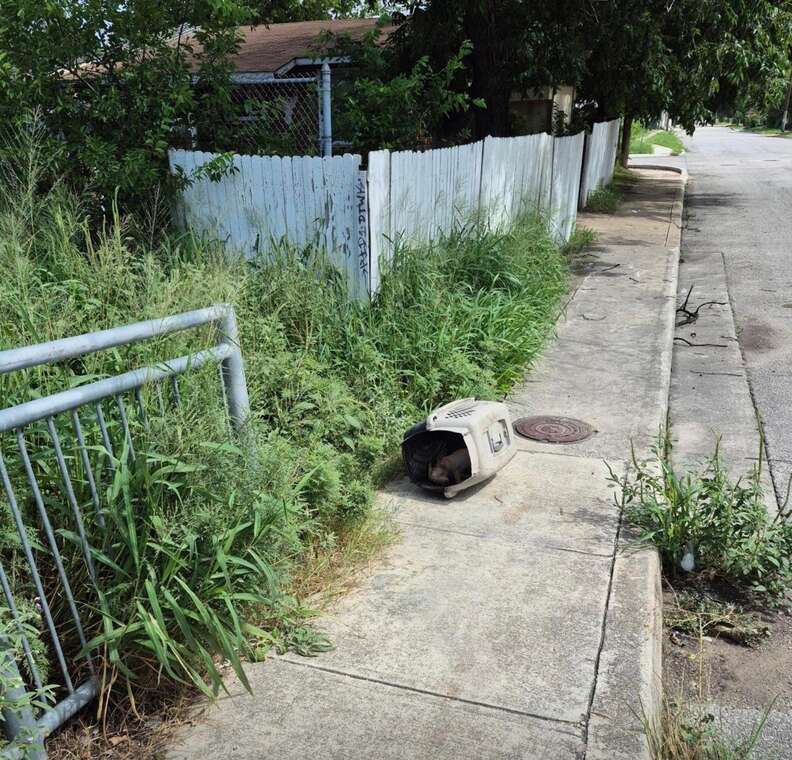
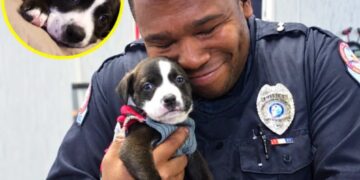
Animal Care Officer Garza was dispatched to investigate.
When Garza approached the crate, he found a little dog lying almost completely still. Fleas and ticks covered his body. His eyes followed the officer’s movements, but the rest of him hardly moved.
The dog, who would initially be named Leo, appeared exhausted and frightened.
Lisa Norwood, public relations manager for San Antonio Animal Care Services, later described the rescue to The Dodo. She explained that Leo remained motionless as Officer Garza approached, watching him with his eyes.
But something changed whenever the officer reached inside to examine him.
Leo would suddenly retreat toward the back of the crate, pressing himself into the smallest space he could find.
Even in his weakened condition, he was trying to keep a stranger from touching him.
The behavior concerned the officer. Leo seemed so reluctant to move that the rescue team initially wondered whether he had been struck by a vehicle.
There was no way to know what had happened to him before he was found. Perhaps he had been injured. Perhaps someone had left him there. Whatever the explanation, he was a small, frightened animal in desperate need of help.
Officer Garza needed to get him somewhere safe.
Rather than force Leo out of the crate, the officer used it as a makeshift stretcher. He carefully loaded the dog, still inside, into his air-conditioned animal care truck and headed toward the SAACS medical facility.
During the drive, something encouraging happened.
As the air inside the truck cooled, Leo slowly began to raise his head.
It was a small movement, but it was more than he had managed when the officer first found him.
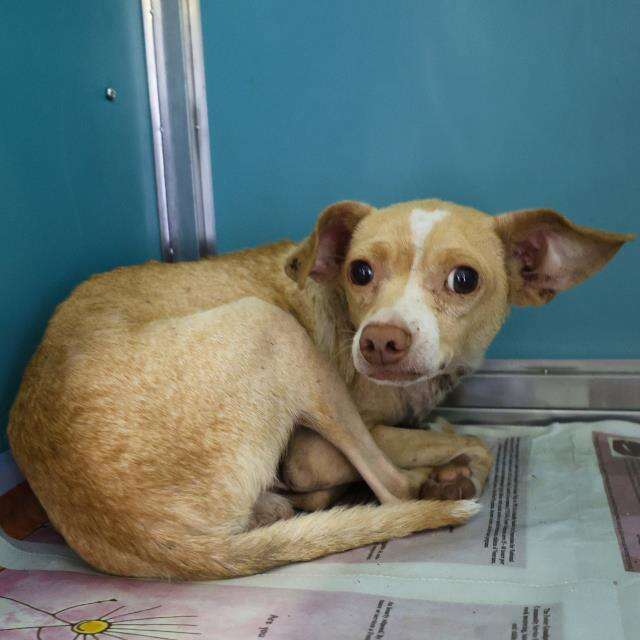
For a dog who had been lying almost motionless in the Texas heat, that little sign of responsiveness mattered.
At the medical facility, staff began assessing his condition.
Leo weighed only 14 pounds and was slightly underweight. His body was covered with fleas and ticks, which the veterinary team treated. He also received vaccinations, and staff offered him wet food.
Fortunately, the examination revealed no injuries.
That was a relief, particularly given the initial concern that he might have been hit by a car.
Yet being physically uninjured didn’t mean Leo was doing well.
He refused to eat.
He remained withdrawn and frightened, barely moving unless someone reached toward him. When that happened, he would cower and try to make himself smaller.
The people caring for him could see that he was deeply uncomfortable around human contact.
Norwood told The Dodo that Leo seemed to have experienced a difficult life, although no one knew whether people had mistreated him or what had caused his fear.
That distinction mattered. His behavior suggested distress, but the circumstances of his past remained unknown.
What the shelter staff did know was that he needed more than treatment for parasites and a place to rest.
He needed time. He needed a quiet environment. Most of all, he needed people who would allow him to become comfortable at his own pace.
Fortunately, another organization was ready to help.
SNIPSA, a San Antonio rescue group that partners with the city’s animal care services, learned about Leo and decided to take him into its care.
The organization began looking for a foster home where he could recover away from the busy shelter environment.
It also gave him a new name.
Leo became Arroyo.
The Spanish word arroyo refers to a stream or creek, often one that remains dry for part of the year. It was a fitting name for a dog discovered near a dry creek bed.
The name connected him to the place where his rescue began, but his circumstances were about to become very different.
SNIPSA estimated that Arroyo was approximately 5 years old. Although he was a small dog, he was no puppy. No one knew how much of his life he had spent without consistent care or whether he had ever experienced the comfort of a stable home.
The rescue quickly arranged for him to stay with a caring foster family.
For the first time since his discovery, Arroyo had a soft bed waiting for him.
He had a blanket, toys, and an air-conditioned home where he could rest comfortably.
Those were ordinary things in many households. For Arroyo, they represented an enormous change from the dirty plastic crate where Officer Garza had found him.
And the difference soon began to show.
During his first few days in foster care, Arroyo started relaxing around the person caring for him.
He was still a shy dog, and his recovery wasn’t something that could be measured by a single dramatic moment. But his foster caregiver began noticing signs that he was becoming more comfortable.
He allowed gentle petting.
Then he began accepting food directly from human hands.
That second change was especially meaningful.
At the animal care facility, Arroyo had been so frightened and withdrawn that he wouldn’t eat the food offered to him. Now, in a quieter setting, he was willing to approach the very hands he had previously tried to avoid.
It didn’t mean every trace of his fear had disappeared. Building trust takes time, particularly when an animal’s background is unknown.
But Arroyo was beginning to learn that human attention could bring something pleasant.
A gentle touch.
A little food.
The familiar comfort of someone caring for him.
There was no need to rush him. His foster home gave him the opportunity to settle in without having to navigate the constant activity of a shelter.
For the rescue workers who had seen his condition when he arrived, those small improvements were encouraging.
Only days earlier, Arroyo had been lying in a crate beside a road, his body covered in parasites and his eyes following the movements of a stranger.
Now he was resting in a comfortable home, surrounded by things that had been provided specifically for him.
His physical condition had improved, but perhaps the most noticeable difference was in how he responded to people.
He was beginning to accept their kindness.
Officer Garza had initially feared that the dog might have been seriously injured or deliberately left in the crate. Neither possibility had been confirmed, but the officer had understood how dangerous the situation was.
Without the anonymous caller and the timely response from Animal Care Services, Arroyo’s circumstances could have become much worse.
Instead, that phone call brought him to people who could help.
SAACS provided the immediate rescue and medical attention. SNIPSA arranged the next stage of his recovery. And his foster caregiver offered the quiet, everyday reassurance that a frightened dog needed.
Each part of that effort mattered.
By the time The Dodo shared his story on July 17, 2025, Arroyo had another promising development in his future.
Someone was already interested in adopting him.
A prospective adopter had begun the application process, raising the possibility that Arroyo might soon have a permanent family of his own.
There was no confirmed adoption announcement at that point, so his story wasn’t quite finished. But the progress he had made in such a short time gave his rescuers good reason to feel hopeful.
The little dog who once wouldn’t lift his head was now allowing himself to be touched and accepting food from a person’s hand.
Those may seem like modest accomplishments to someone accustomed to a friendly, confident dog.
For Arroyo, they were important steps.
It is difficult to look at the photographs of him resting comfortably in his foster home without remembering where he was found.
The crate had been dirty, exposed to the summer heat, and sitting beside a road where people drove past without knowing a living animal was inside.
Officer Garza couldn’t have known what kind of dog he would find when he answered that call. He found a frightened little animal who needed medical attention, protection from the heat, and somewhere safe to recover.
And because the right people responded, Arroyo received all three.
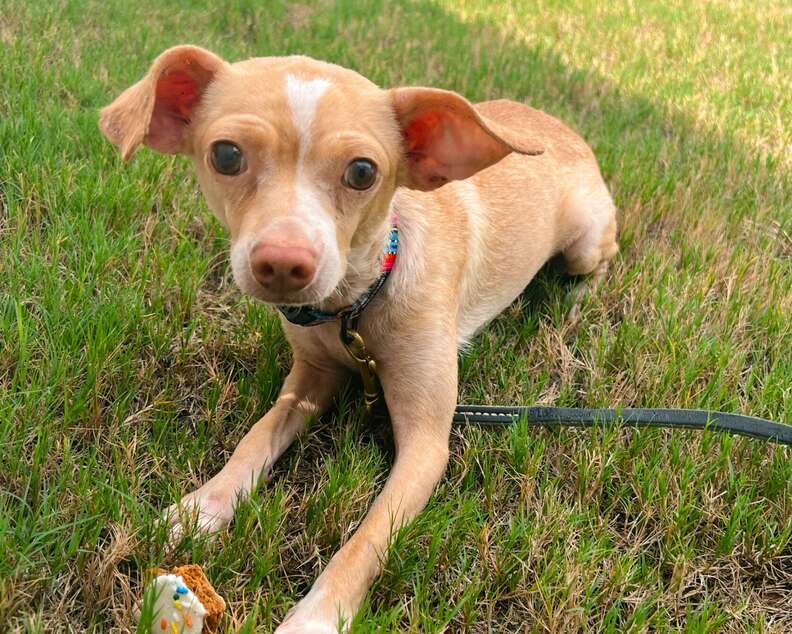
His story is a reminder that helping a frightened animal doesn’t always produce an immediate, joyful transformation. Sometimes the earliest signs of progress are almost unnoticeable.
A dog lifts his head.
He stops retreating quite so far when someone approaches.
He accepts a gentle touch.
And one day, he takes food from a hand he has begun to trust.
For Arroyo, those quiet moments were the beginning of a different life.
Whatever happened before he was discovered near that dry creek bed, his future no longer depended on surviving alone inside a plastic crate.
He had people looking after him, a comfortable place to sleep, and the possibility of a permanent home.
After everything the little dog had been through, that was a very good place to begin.
If Arroyo’s story touched you, consider sharing it with a friend who understands how much patience and kindness can mean to a frightened rescue dog.
Source: Reporting by Sarah Ashley for The Dodo, July 17, 2025. Rescue information provided by San Antonio Animal Care Services and SNIPSA.



Discussion about this post