












Sam disappeared in less time than it took anyone to understand what was happening.
One moment, he was near the campsite with his family.
Then a deer broke through the trees.
Sam ran after it.
Someone shouted his name.
Branches moved.
Then the forest became still again.
His family expected him to circle back.
Minutes passed.
Then an hour.
By evening, they were walking the trails with flashlights.
By the end of the week, they had covered miles.
By the end of the month, they had done almost everything they could think of.
Sam never returned.
Eventually, they had to drive away from the mountain without him.
For the next year, however, they kept coming back.
Then, exactly 365 days after Sam disappeared, they drove up the same mountain road once more.
Beside a familiar mile marker sat an emaciated dog.
At first, they could barely recognize him.
Then he lifted his head.
It was Sam.
The Camping Trip Had Started Like Any Other
There had been no warning that the trip would become something the family measured their lives around for the next year.
Sam knew camping.
He liked being outside.
He liked investigating the smells around camp and walking the trails with his family.
Nothing about that morning seemed unusual.
Then the deer appeared.
For a dog with prey drive, a running animal can trigger an immediate chase before training or recall catches up.
Sam bolted.
His family called.
He kept going.
Within moments, trees and uneven terrain blocked him from view.
At first, nobody panicked.
Dogs sometimes chase briefly and return when the excitement fades.
So they waited.
Then they began searching.
Darkness Changed the Search
The mountains looked different after sunset.
Trails that felt obvious during daylight disappeared into blackness.
Every movement in the brush sounded important.
Every distant shape looked like a dog.
The family walked with flashlights and called Sam’s name.
They returned to the campsite repeatedly in case he had doubled back.
They left familiar items outside.
Food.
Water.
His blanket.
Morning came.
Sam had not returned.
They widened the search.
Other campers were told what had happened.
Posters went up.
Nearby roads were checked.
Anyone who might have seen a loose dog received Sam’s description.
Still, there was nothing certain.
They Stayed Much Longer Than Planned
A weekend camping trip became weeks in the mountains.
Someone needed to remain near the campsite in case Sam returned.
The family organized their days around searching.
Morning trails.
Roads in the afternoon.
Quiet listening near dusk.
They called shelters and veterinary clinics.
They checked sightings that led nowhere.
Sometimes a person reported a dog in the distance.
The family drove there.
Wrong color.
Wrong size.
Wrong dog.
Hope became exhausting.
But leaving felt worse.
Nearly a month passed before practical reality finally won.
Jobs were waiting.
Bills continued.
They could not stay on the mountain indefinitely.
Eventually, they packed the vehicle.
Sam’s things went into the car without Sam.
The Drive Home Was the Part They Had Dreaded
The family kept looking through the windows as the road wound downward.
Every turnout became one more place Sam might suddenly appear.
Every dog-shaped shadow created a second of hope.
Then the mountain disappeared behind them.
At home, Sam’s absence filled ordinary spaces.
His bowl.
The place where he slept.
The leash that no longer needed to be picked up.
People sometimes imagine losing a pet as either death or recovery.
A missing animal creates a different kind of uncertainty.
There is no clear answer.
No goodbye.
Only possibilities.
Maybe someone found him.
Maybe he was still moving through the wilderness.
Maybe something had happened that the family would never know.
They tried not to choose between those possibilities.
They Kept Returning
Every weekend they reasonably could, they drove back toward the mountain.
The trip became routine.
They checked familiar trails.
Talked with people in the area.
Left food in places where it could be monitored.
They sometimes placed Sam’s blanket near the campsite because familiar scent might help a roaming dog recognize the location if he happened to pass nearby.
Wildlife could find food too, of course, so they could never assume an empty bowl meant Sam had been there.
There were no clear tracks.
No photograph.
No reliable sighting.
Still, they came back.
Spring became summer.
Summer moved toward fall.
Then winter returned.
The Mountains Were Too Large for Certainty
As the months passed, the family had to accept something painful.
They did not know where Sam was.
The original version of the story would later describe him as remaining beside the same road for an entire year, faithfully waiting for the family to return.
There is no way to know that.
A lost dog surviving in mountainous terrain would almost certainly need to move in search of water, food, shelter, or safer conditions.
Sam may have ranged over a large area.
He may have followed roads or trails.
He could have approached campsites after people left.
Perhaps someone fed him without realizing he was missing.
His life during those 365 days remained unknown.
What the family knew came later.
When they returned one year after losing him, Sam was near the place they remembered.
The Anniversary Did Not Feel Like Something to Celebrate
The number had weight.
One year.
They had spent twelve months measuring weekends against the same question.
What if this is the trip when we find him?
The answer had always been no.
Still, they drove up.
The road was familiar now.
They knew the curves.
The overlooks.
The places where signal disappeared.
As they approached the area where Sam had vanished, one of them noticed something near a mile marker.
At first, it looked like a small animal sitting beside the road.
Then the vehicle slowed.
The dog did not run.
They pulled over.
For several seconds, nobody spoke.
The Dog Barely Looked Like Sam
He was far thinner than the dog they remembered.
His coat was dirty.
Ticks clung to him.
His body looked depleted from whatever the previous months had required of him.
The family did not immediately rush forward.
A dog that has survived alone for a long time may behave differently, even around familiar people.
Fear, exhaustion, pain, or illness can change responses.
They called his name.
“Sam.”
The dog’s head lifted.
They called again.
Then recognition seemed to pass through the group before anyone trusted it enough to say it aloud.
The markings matched.
The face, despite the weight loss, was familiar.
It was Sam.
What Sam Understood Could Not Be Known
The family wanted to believe he had been waiting for them.
That he had remained near the place where their vehicle had been parked.
That somehow he knew they would return.
It is an understandable interpretation.
But dogs do not understand anniversaries or promises about returning a year later.
What Sam could remember were far more immediate things.
Voices.
Scents.
Places.
People associated with safety and food.
Dogs are capable of recognizing familiar individuals after long separations.
The mountain itself may also have become familiar territory during the year.
Finding Sam near the original location was remarkable.
It did not require imagining that he had consciously counted the days.
They Approached Slowly
Sam looked exhausted.
His family crouched rather than standing over him.
They spoke in voices he had known long before the camping trip.
He did not leap toward them.
He did not suddenly become the strong dog they remembered.
Instead, he allowed the distance to close.
When one of them finally touched him, the dog’s body seemed almost weightless compared with before.
They checked him quickly for obvious injuries.
His condition made one thing clear.
This was not the moment for a long emotional reunion on the roadside.
Sam needed medical care.
The family lifted him carefully.
Then carried him to the vehicle.
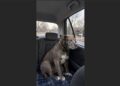
Sam Fell Asleep in the Car
He licked one familiar face once.
Then he curled against the seat.
Within minutes, his eyes closed.
The family cried quietly around him.
The scene became the emotional center of the story when they later described it.
A dog missing for a year.
Back in the same car.
Sleeping.
But exhaustion in a severely underweight animal is not something to romanticize.
Sam’s condition was concerning.
A year outdoors could have exposed him to parasites, dehydration, malnutrition, injuries, infectious disease, and other problems that were not visible from the roadside.
The reunion was only the beginning of what he needed.
The First Destination Needed to Be a Veterinarian
A dog in Sam’s condition should not simply be given a huge meal and allowed to sleep for several days without evaluation.
After prolonged food deprivation or significant weight loss, nutrition may need to be restored carefully.
Veterinary assessment can check hydration, blood work, organ function, parasite burden, injuries, and other problems.
Ticks also create risks that vary by region and exposure.
Sam needed more than love and a warm car.
He needed professional care.
His family could finally provide it.
That was one of the biggest differences between the moment he disappeared and the moment they found him.
For twelve months, they had been unable to protect him.
Now they could make decisions for him again.
Coming Home Would Be Another Adjustment
Finding a lost dog does not necessarily mean the animal immediately resumes its previous life.
Sam had spent an unknown amount of time surviving without his old household routines.
His body had changed.
His behavior might have changed too.
The family would need to keep his world quiet.
Predictable.
Secure.
Doors and gates would need extra attention.
Outdoor time would need supervision.
If Sam startled easily or seemed uncertain in familiar rooms, he would need patience rather than pressure.
Some dogs settle rapidly after reunion.
Others require time.
Neither response means the animal has forgotten its family.
The Family Would Never Know Most of What Happened
That may have been the strangest part.
Sam had lived an entire year beyond their sight.
Where did he sleep during winter?
What did he eat?
Did he spend weeks near campgrounds?
Did he follow wildlife trails?
Did anyone see him without realizing somebody was searching?
How far did he travel?
There were no answers.
His thin body could confirm that survival had been difficult.
It could not tell the story.
The family eventually stopped trying to invent one.
Sam was home.
That had to be enough.
The Mile Marker Became Something Different
For a year, that stretch of road had represented failure.
It was the place where their dog disappeared.
Every return brought them back to the moment when they had called his name and heard nothing.
After the reunion, the same road held another memory.
A thin dog sitting near the shoulder.
A vehicle slowing.
Someone saying, “Stop.”
Then Sam lifting his head.
Places do not change.
The meaning attached to them can.
The Story Is Powerful Without Saying Sam Waited 365 Days
That version is tempting.
A faithful dog remains in one place through snow, hunger, storms, and loneliness because he knows his family promised to return.
It sounds beautiful.
It also asks us to claim things we cannot know.
The truth is enough.
Sam disappeared in the mountains.
His family searched for weeks.
They returned repeatedly for a year.
Exactly one year later, they found a severely underweight dog near the place where they had lost him.
It was Sam.
That is already extraordinary.
His survival did not need a human explanation to matter.
What Kept the Family Going Was Uncertainty
Each weekend trip could have been pointless.
Most of them probably felt that way.
They drove up.
Looked.
Called.
Waited.
Returned home without him.
There was no guarantee persistence would produce a reunion.
That is important too.
Searching for a missing animal is not a bargain.
Effort does not guarantee recovery.
Sometimes animals are found.
Sometimes they are not.
The family continued because not knowing allowed hope to remain.
On the 365th day, hope happened to meet them beside the road.
Sam’s Recovery Would Matter More Than the Viral Moment
The photograph people would want to see is obvious.
Sam back home.
Weight restored.
Tail moving.
Perhaps lying on his old bed.
Those images would be reassuring.
But recovery should not be reduced to appearance.
Sam’s progress would need to be measured through health.
Appetite.
Hydration.
Mobility.
Rest.
Comfort.
Parasite treatment.
Veterinary follow-up.
And the return of ordinary behavior.
The best ending would not be Sam smiling for a photograph.
It would be a dog whose days had become uneventful again.
Nobody Needed to Ask Him Where He Had Been
He could not answer.
So the family concentrated on what came next.
Food appropriate to his condition.
Water.
Medical treatment.
Sleep.
A secure home.
Familiar voices.
Later, when he was strong enough, short walks.
There would be time for photographs.
Time to sit beside him.
Time to remember the year when they did not know whether he was alive.
For now, Sam needed to recover.
The Search Ended Where It Had Begun
A year earlier, the family had driven down the mountain with an empty place in the vehicle.
This time, Sam occupied it.
He was thin.
Weak.
Covered with evidence of a hard life outside.
But he was there.
His head rested against the seat.
The road curved downward.
No one needed to look through the windows for him anymore.
They already knew where he was.
The family could not know whether Sam had been waiting at that mile marker or whether he had arrived there only hours earlier.
They could not know what memory, scent, chance, or survival pattern had brought him back to that stretch of road.
They knew only one thing with certainty.
For 365 days, they had continued returning to the mountain without finding their dog.
On the next drive home, they did not leave him behind.
Sam slept in the car beside them.
And this time, when the mountain disappeared in the rearview mirror, he was going home too.
Editor’s Note: The characters in this story are fictional. Through these stories, we hope to share the intelligence, loyalty, compassion, and loving nature of dogs with people everywhere.







Discussion about this post