




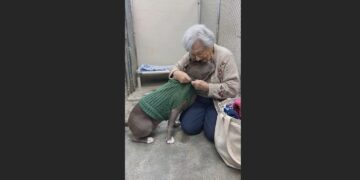








When we agreed to bring Bruce home, we believed we were giving an elderly dog a comfortable place to spend the final chapter of his life.
We weren’t expecting years of companionship. We weren’t imagining long afternoons filled with games or a house made lively by an energetic dog.
We were preparing for something much quieter.
Bruce was 15 years old, a senior pit bull with cloudy eyes, a slow, careful walk, and a tired expression that made him look older than his years.
His shelter paperwork carried a designation that told us what kind of responsibility we were accepting.
Hospice Foster.
His previous owners had surrendered him because he slept too much and had difficulty moving around. At his age, those concerns seemed serious enough that the shelter had placed him in its hospice program.
We understood that his remaining time might be limited.
And we were willing to give him whatever comfort we could.
What we didn’t know was that Bruce still had a surprisingly playful side.
We just hadn’t met that part of him yet.
A Home Prepared for a Gentle Goodbye
When we first learned about Bruce, we tried to be realistic about what bringing him home would mean.
At 15, he was an exceptionally old dog. His movements were slow, and the description in his shelter file suggested that much of his day was spent sleeping.
We knew that caring for a senior animal could involve difficult decisions and the possibility of loss sooner than we wanted.
Still, we couldn’t bear the thought of Bruce spending whatever time remained in an unfamiliar kennel when we had a home where he could rest comfortably.
We weren’t looking for an active companion who would fit into every part of our routine. We were simply hoping to make his days easier.
So we began preparing the house.
We placed thick orthopedic beds in different rooms, making sure Bruce would have somewhere soft to lie down without having to walk very far.
We installed small ramps to help him avoid the stairs. We considered how he would move around and tried to reduce anything that might make an already difficult task harder.
The goal wasn’t to encourage him to do more.
It was to make sure he wouldn’t have to struggle.
We imagined slow mornings when he could sleep as long as he wanted. We pictured quiet afternoons, comfortable places to rest, and evenings when he could settle down without being disturbed.
If Bruce wanted nothing more than a soft bed and a peaceful home, we would be content to give him exactly that.
We didn’t expect him to entertain us.
We didn’t expect him to change.
And we certainly didn’t expect him to become the mischievous old dog who would eventually start stealing pizza.
At the time, our thoughts were occupied by something much more serious.
We were preparing ourselves to say goodbye.
The First Week: A Dog Who Needed Rest
When Bruce arrived, his behavior seemed consistent with everything we’d been told.
He slept.
He slept for long stretches, moving only when he needed to and showing little interest in activity.
His steps were still careful, and there was nothing about his early behavior that suggested he was ready to become an energetic member of the household.
But as we watched him rest, we noticed something that brought us a little comfort.
He seemed peaceful.
His sleep didn’t appear restless or unsettled. He lay on the soft beds we’d prepared, resting deeply in a way that made us hope he was finally comfortable.
We couldn’t know exactly what he was experiencing. Perhaps he was exhausted by the change in his circumstances. Perhaps his age was simply catching up with him.
Or perhaps the quiet surroundings were allowing him to relax.
Whatever the reason, we decided to let him be.
There was no need to hurry him into a routine or insist that he become more active.
We had brought him home to provide comfort, and if that meant allowing him to spend most of the day asleep, we were happy to do it.
I remember thinking that this might be what hospice fostering looked like.
A peaceful house. A comfortable bed. An elderly dog who didn’t need much beyond patience and care.
It wasn’t the joyful, playful experience people often imagine when they adopt a dog.
But there was something meaningful about it.
Bruce had reached an age when he deserved to have his needs respected without being asked to give anything in return.
We didn’t need him to be entertaining or affectionate.
We just wanted him to feel safe.
And during that first week, watching him settle into the beds we’d prepared, I thought we were succeeding.
The Second Week: Small Changes We Hadn’t Expected
During Bruce’s second week with us, we began noticing a subtle difference.
He still slept plenty, and he was still an old dog whose movements required care.
But something about his behavior seemed to change.
He appeared more comfortable in the house.
The cautious way he’d carried himself during his first days began giving way to a little more confidence.
We couldn’t say exactly when the change began.
There wasn’t one dramatic moment when Bruce suddenly behaved like a different dog.
It happened gradually enough that we almost missed it.
But by the end of his second week, we were beginning to wonder whether we’d misunderstood what he needed.
Maybe he was becoming familiar with his surroundings.
Maybe he was learning that this home wasn’t another temporary stop.
Perhaps the quiet routine and comfortable places to rest were helping him feel better.
We liked to imagine that Bruce was beginning to understand that he belonged here.
Of course, there was no way to know what he understood about his situation.
But he seemed to be settling into his new surroundings.
And that was enough to make us hopeful.
At first, we didn’t allow ourselves to expect much more.
Bruce was still 15 years old. His eyes were still cloudy, and his body was still aging.
We hadn’t forgotten why he’d been placed in hospice foster care.
We were simply grateful that he appeared to be getting comfortable.
Then, during his third week, something happened that changed the way we looked at him.
The Third Week: An Old Toy Becomes His Favorite Possession
Bruce discovered a stuffed toy.
It wasn’t an expensive new purchase or something we’d carefully selected for him.
It was a small, worn plush toy that had been sitting among a pile of old donations.
There was nothing particularly remarkable about it.
The fabric had already seen better days, and it looked like the sort of toy a younger dog might play with briefly before moving on to something more exciting.
But Bruce seemed to think he’d found something wonderful.
He picked it up.
And he didn’t want to put it down.
At first, we were simply pleased to see him interested in something other than sleeping.
We hadn’t expected a dog in hospice care to show much enthusiasm for toys, especially after hearing that he had difficulty getting around.
But Bruce wasn’t just carrying the stuffed animal for a few minutes.
He began taking it with him as he moved through the house.
His steps were still those of a senior dog, but he seemed to have a new purpose.
He had something he wanted to carry.
And wherever he went, that little plush toy often went with him.
It was such an ordinary thing.
Dogs carry toys around their homes every day.
But for Bruce, it marked a change from the withdrawn, sleepy dog we’d welcomed only a few weeks earlier.
The same pit bull we’d been told could barely walk was now moving through the house with his stuffed animal held proudly in his mouth.
And he looked perfectly content doing it.
The Dog Who Supposedly Slept All Day Began Waking Us Up
Soon, Bruce developed another habit that caught us completely off guard.
He started waking us up early in the morning.
When we first brought him home, we’d expected to let him sleep as long as he wanted.
Now he was the one deciding when our mornings should begin.
He would appear with his little stuffed toy in his mouth, ready for us to get out of bed.
I couldn’t help laughing at the contrast.
This was the dog whose previous owners had reportedly surrendered him because he slept too much.
The dog we thought might spend his remaining days resting quietly.
And here he was, making sure we didn’t sleep through the morning.
He didn’t suddenly become a puppy again.
He was still elderly, and we remained mindful of his physical limitations.
But the difference in his enthusiasm was impossible to overlook.
He was showing interest in the household around him.
He had developed a routine that involved more than sleeping.
And, perhaps most surprising of all, he seemed determined to include us in it.
The little stuffed toy became a familiar part of our mornings.
Bruce would carry it proudly, looking entirely pleased with his discovery.
It made us smile every time.
We’d prepared orthopedic beds and ramps, expecting our main responsibility to be keeping an elderly dog comfortable.
We hadn’t anticipated that we’d also be sharing our home with a dog who considered sunrise an excellent time to show off his favorite toy.
A Toy He Refused to Leave Behind
The stuffed animal soon became more than something Bruce carried around during the day.
At night, he wanted it close.
When he settled down to sleep, he would curl around the little plush toy, holding it near his body.
Sometimes it looked almost as though he were protecting it.
I wondered whether he was afraid someone might take it away.
I couldn’t know that, of course.
Perhaps Bruce simply enjoyed the toy’s familiar feel. Maybe he found it comforting to have something soft beside him.
Whatever the explanation, he had become unmistakably attached to it.
We had brought him home with the expectation that he’d need comfortable beds, easy access around the house, and plenty of rest.
We hadn’t thought about how much pleasure one old stuffed animal might bring him.
There was something wonderfully simple about it.
Bruce didn’t need an elaborate collection of toys or constant entertainment.
He’d found something he liked.
And he wanted to keep it close.
We Began to Question What His Hospice Label Really Told Us
As Bruce’s behavior changed, I found myself thinking about the description we’d been given before bringing him home.
He had been surrendered because he slept constantly and struggled to get around.
Those observations had helped shape our expectations.
We’d assumed that his lack of activity meant he was nearing the end of his life.
But now we were seeing a different side of him.
Bruce was becoming more active. He was carrying his toy through the house, waking us in the morning, and showing an interest in things we’d never imagined would matter to him.
It made me wonder how much of his earlier withdrawal had been related to his circumstances.
Had he been lonely?
Had he simply needed a quieter place to rest?
Was the comfort of a consistent home helping him feel better?
We couldn’t answer those questions with certainty.
And I wouldn’t want anyone to mistake his improvement for proof that love had somehow cured a medical condition.
Bruce was still elderly. His physical limitations hadn’t vanished, and we had no reason to believe the normal effects of aging had been reversed.
But it was clear that his earlier behavior hadn’t told us everything about his quality of life.
We’d been so focused on the possibility that Bruce was nearing the end that we hadn’t imagined how much enjoyment he might still find in ordinary days.
Now we were beginning to understand that being old didn’t mean he had stopped wanting to live an interesting life.
He could need extra rest and still enjoy carrying a toy.
He could have difficulty with stairs and still be excited to go outside.
He could be 15 years old and still surprise us.
Those things weren’t contradictions.
They were simply different parts of the same dog.
Bruce Is Still Fifteen, but He’s Full of Surprises
Today, Bruce is still the same elderly pit bull we welcomed into our home.
His eyes remain cloudy, and his age hasn’t changed.
We still have the orthopedic beds.
The ramps are still there to help him move around more comfortably.
And we still pay attention to his physical limitations.
But our daily life with Bruce looks very different from the one we imagined when we first agreed to foster him.
For one thing, he’s developed an unfortunate interest in stealing pizza.
Yes, pizza.
If someone leaves a slice where he can reach it and looks away at the wrong moment, Bruce is more than willing to help himself.
It’s not a habit we encourage, of course.
But I have to admit that discovering our supposedly frail hospice dog had become a sneaky little food thief was funny.
Here was a dog we had prepared to assist with every ordinary movement.
Now he was keeping us alert whenever pizza was around.
And that wasn’t his only surprise.
Bruce also developed a habit of beating me to the back door whenever it was time to go outside.
I don’t know where he finds the enthusiasm.
But somehow, when he realizes there’s an opportunity to head into the yard, that old body seems to remember it still has places to go.
His movements aren’t those of a young dog, and we don’t expect them to be.
Yet the eagerness is unmistakable.
He wants to be part of what is happening.
He wants to go outside.
And, apparently, he wants to get to the door before I do.
Sometimes I catch myself smiling as he heads toward it.
When we first brought him home, we’d been prepared for a quiet life centered on rest and comfort.
Now our days include an old pit bull with an enthusiasm for the backyard, a questionable interest in pizza, and a stuffed toy that rarely leaves his side.
It’s a different life from the one we expected.
And we love it.
The Little Stuffed Toy That Still Goes Everywhere
Through all these changes, one thing has remained constant.
Bruce still carries that old stuffed toy.
It isn’t new, beautiful, or especially impressive.
It doesn’t need to be.
For reasons only Bruce could explain, if he had words, that little piece of worn fabric has become his favorite possession.
He carries it through the house.
He brings it when he wakes us in the morning.
And when the day is over, he curls up with it nearby.
I often think about the contrast between the way Bruce arrived and the way he lives now.
During his first week, he seemed interested in little beyond sleeping.
We were careful not to ask too much from him because we believed his body was nearing the end of what it could manage.
But the old toy helped us discover that Bruce still had preferences, habits, and a playful side that had been hidden from us.
He didn’t need to become younger to show those qualities.
He simply needed the opportunity to express them.
That stuffed animal has become a reminder of how much we didn’t know about him when he first came home.
It would have been easy to see only his age.
It would have been easy to assume that because his file said “Hospice Foster,” there was nothing more to discover.
Instead, we found ourselves getting to know an elderly dog whose personality was still unfolding.
And somehow, that little toy became part of nearly every happy moment.
We Prepared for His Final Days. Bruce Reminded Us to Enjoy the Days We Have.
I still remember the way we felt when we agreed to bring Bruce home.
We were realistic about the possibility of losing him.
We knew he was old.
We understood that his health and mobility might decline, and we wanted to make sure he would have a peaceful place to rest when that happened.
We had already begun preparing ourselves for the emotional difficulty of saying goodbye.
That part of caring for a senior animal hasn’t disappeared.
Bruce is 15, and we know that our time together may still be limited.
His newfound enthusiasm doesn’t promise us years we weren’t expecting.
But it has changed how we think about the time we have.
At first, we were so concerned about making his ending comfortable that we almost overlooked the possibility of giving him an enjoyable present.
We saw an elderly dog who needed help.
Now we see Bruce.
A slightly mischievous pit bull who likes pizza more than he should.
A dog who wants to be first to the backyard door.
A companion who wakes us in the morning with a stuffed animal in his mouth.
And an old fellow who seems perfectly content curling around that same toy when it’s time to sleep.
I don’t know how much longer Bruce will be with us.
I wish I did.
But I’ve stopped thinking of every day as another step toward an inevitable farewell.
Instead, I try to appreciate the ordinary moments while they’re happening.
The quiet mornings when he rests comfortably.
The unexpected moments when he moves with more enthusiasm than we anticipated.
The familiar sight of him carrying his beloved toy from room to room.
And even the occasions when we have to be particularly careful about where we leave our pizza.
Those are the things that make a life together.
They may seem small, but they are the moments that have allowed us to know Bruce as more than an elderly dog with a hospice designation.
He has become a member of our family.
We still intend to give him all the comfort he needs as he grows older.
We’ll continue making his surroundings easy to navigate. We’ll respect the days when he wants extra rest, and we’ll be there when his needs change.
But we’ll also make room for his little bursts of enthusiasm.
For his morning visits with that stuffed toy.
For his determination to beat me to the back door.
And for the playful personality that took us by surprise.
When we brought Bruce home, we believed we were giving him somewhere peaceful to spend the end of his life.
Instead, he showed us that an old dog can still have plenty of living to do.
We didn’t reverse his age.
We didn’t erase the years behind him.
And we can’t know exactly what made him begin enjoying his surroundings so much more.
But we gave him a comfortable home, and over time, he began showing us a side of himself we hadn’t expected.
That’s something I’ll always be grateful for.
Because whenever I see Bruce carrying that little stuffed toy, I remember how differently we imagined our time together.
We thought we’d be helping a tired old pit bull say goodbye.
Instead, we found ourselves welcoming him into a new chapter of his life.
And for as long as he wants to keep carrying that toy, stealing the occasional opportunity to reach for pizza, and hurrying toward the back door ahead of me, we’ll be right here enjoying those days with him.
Bruce may be 15 years old.
But he’s still Bruce.
And that turns out to be more than enough.









Discussion about this post